
Miami-Dade Corrections Boot Camp Program Inmate Population
The Miami-Dade Corrections Boot Camp Program is administered by the Miami-Dade Corrections and Rehabilitation Department, the same county agency that runs Turner Guilford Knight Correctional Center, Metro West Detention Center, and the Pre-Trial Detention Center. MDCR lists Boot Camp among its facilities on the department contact page with a direct program phone number of 786-263-5810. Unlike the three county jail buildings, Boot Camp does not have a separately published street address on the current MDCR contact page. For administrative and correspondence purposes, the MDCR headquarters address is 3505 NW 107 Ave, Doral, FL 33178, reachable at 786-263-7000.
MDCR's Boot Camp Program page describes the program as shock incarceration combined with regimented inmate discipline. "Shock incarceration" is a corrections term for a short, highly structured sentence designed to change behavior through military-style structure rather than long-term confinement. The program includes academic education, vocational training, rehabilitative services, financial-literacy instruction, job-placement support, and related programming. These services are meant to give participants skills that reduce the likelihood of returning to the criminal justice system.
The current MDCR daily population report placed Boot Camp I with 9 people in custody on May 28, 2026. This small count reflects the program's specialized purpose. Boot Camp serves a narrow, defined group rather than the broad general jail population. Official capacity for the program was not located in the current MDCR contact page or other current official sources reviewed; no capacity figure is stated here because none was confirmed.
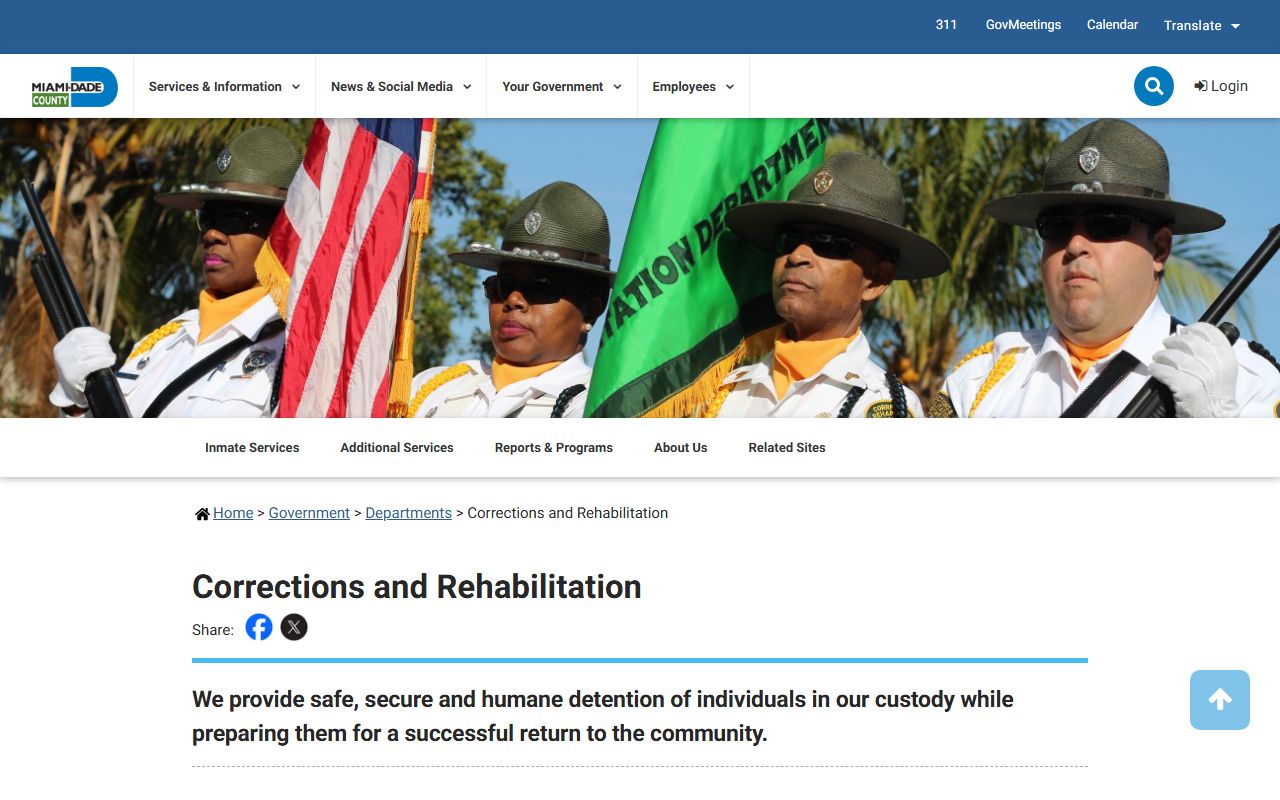
The MDCR homepage describes the department's full range of programs and custody options, including Boot Camp, which sits alongside the broader mission of operating Miami-Dade's county corrections system.
Boot Camp Program Inmates: Who Is Sentenced Here
The Boot Camp Program does not hold the general pretrial or county-sentenced population. Participation follows a specific sentencing path. According to the MDCR Boot Camp page, participants sentenced to Boot Camp primarily consist of young men and women between the ages of 14 and 24. Participants under the age of 18 have been adjudicated as adults, meaning a Florida court made a formal determination that the case should proceed in adult criminal court rather than juvenile court.
This distinction matters for lookup purposes. A young person in Boot Camp has been convicted as an adult and is serving a county-level sentence under MDCR supervision. They are not a pretrial detainee awaiting a hearing, and they are not a juvenile under the jurisdiction of the Florida Department of Juvenile Justice. Because they are in MDCR county custody, the MDCR Inmate Search is the starting point for locating them. The Boot Camp I location code appears in the MDCR daily population PDF as the field label for this program population.
Boot Camp differs from Miami-Dade's other custody options in both population and purpose. Metro West Detention Center and Pre-Trial Detention Center hold large numbers of people across all charge categories, mostly pretrial. Turner Guilford Knight serves as the central intake, processing, and release hub for the whole MDCR system. Boot Camp, by contrast, is a small, targeted program that accepts people after conviction and after a sentencing decision specifically designating Boot Camp as the appropriate placement. The decision to sentence someone to Boot Camp rather than standard county detention is made by the court, not by MDCR.
- Shock incarceration
- A corrections approach that uses a short, highly structured program modeled on military boot camps. It stresses discipline, physical training, and structured schedules rather than long-term confinement.
- Adjudicated as an adult
- A court determination that a person under the age of 18 will be tried and sentenced in adult criminal court rather than the juvenile justice system.
- MDCR
- Miami-Dade Corrections and Rehabilitation Department; the county agency that operates all four Miami-Dade county correction facilities including Boot Camp.
- Boot Camp I
- The label used in MDCR's daily population PDF to identify people counted in the Boot Camp Program on a given day.
How to Look Up a Boot Camp Program Participant
Because the Boot Camp Program is a county corrections program under MDCR, custody searches use the same MDCR Inmate Search that covers all four Miami-Dade county facilities. The form asks for last name and first name, each with a minimum of three characters. There is no separate Boot Camp-only roster form and no booking-number field on the public version of the search. Results from a successful search show the person's name, date of birth, race, sex, facility or location, charges, bond amount, jail number, booking date and time, and a mugshot photo.
Because Boot Camp holds a very small number of people at any one time, the search may return no result if the person has completed the program and been released. The MDCR FAQ states that the online inmate search includes inmates released within the past 72 hours, so recent program completions may still appear briefly. After that window, a records request through MDCR Central Records or the county's GovQA portal is the next step for historical information.
If the online search does not produce a result and you believe the person is in Boot Camp, call MDCR directly. The Boot Camp Program phone is 786-263-5810. The MDCR main line at 786-263-7000 can also route calls to the appropriate unit. MDCR's Inmate Records line at 786-263-4222 handles custody-status inquiries. Program participants who have been sentenced to a longer term with the state prison system would not appear in MDCR's roster at all; those individuals would be found through the Florida Department of Corrections Offender Search instead.
- Open the MDCR Inmate Search at the Miami-Dade corrections portal.
- Enter at least three characters in the Last Name field and at least three characters in the First Name field, then select Search.
- Review the results; check the Location column for a Boot Camp or Boot Camp I designation.
- Open the record to see charges, bond information, jail number, and booking details.
- If no result appears, call 786-263-5810 (Boot Camp Program) or 786-263-7000 (MDCR main) to confirm current custody status.
Note: If the person is under 18 and was NOT adjudicated as an adult, they would be in juvenile justice custody, not MDCR county corrections custody. The MDCR roster covers adult and adult-adjudicated participants only.
Boot Camp Program Contact and MDCR Headquarters
The Boot Camp Program does not have a separately published street address on the current MDCR contact page. Contact for Boot Camp participants and their families goes through the program phone line and through the broader MDCR channel structure. For administrative records and public-records requests, the MDCR headquarters address and Central Records contacts apply. Confirm any program-specific rules, current address, or visit scheduling directly with MDCR before making plans.
Miami-Dade Corrections Boot Camp Program
Administered by Miami-Dade Corrections and Rehabilitation Department
Street address not separately published on current MDCR contact page
786-263-5810 (Boot Camp Program)
MDCR HQ: 3505 NW 107 Ave, Doral, FL 33178 | 786-263-7000
Boot Camp Program Services and MDCR Programming
The Boot Camp Program combines regimented discipline with a set of services designed to address the causes of criminal behavior and prepare participants for life after release. MDCR describes the program as including academic education, vocational training, rehabilitative services, financial-literacy instruction, and job-placement support. These are not supplementary add-ons; they are core components of the program. Participants work on practical skills at the same time they are held to a structured, disciplined daily routine.
Academic programming in a corrections boot camp context typically covers basic and secondary-level education, including GED preparation where a participant does not yet hold a diploma. Vocational training builds work-ready skills in trades or industries that offer employment after release. Financial literacy covers budgeting, credit basics, and related topics that many justice-involved young people have not had access to through traditional schooling. Job placement helps participants connect with employers and opportunities before they exit the program, reducing the gap between release and stable employment.
Boot Camp sits within MDCR's broader spectrum of alternatives to standard detention. Other MDCR programs include Reentry Services, which helps people leaving any MDCR facility build skills through counseling, case management, and community support. The Monitored Release Program keeps certain people under house arrest with ankle bracelet supervision as a community-based option. Pretrial Services handles some defendants who are released before trial at no cost, supervised to ensure court appearances. These programs address different points in the criminal justice process, and Boot Camp occupies the post-conviction, pre-release space for young sentenced offenders specifically.
Because Boot Camp runs as a program rather than a traditional jail building, some standard facility details may not apply or may require direct confirmation with MDCR. The number of participants on any given day is small; the May 28, 2026 daily population PDF listed 9 people in Boot Camp I. Program length, exact daily schedule, and specific program-completion conditions are governed by the sentencing order and MDCR operational rules, not published as a standard facility data sheet.
Visiting a Boot Camp Program Participant
Visitation for Boot Camp participants follows MDCR's standard county corrections channels, but because the program uses regimented discipline and a structured schedule, some rules may differ from general county jail visitation. MDCR operates remote video visitation through GTL as the standard contact method across the department. Families should confirm with MDCR specifically whether GTL remote video visitation applies to Boot Camp participants under the same terms as the general county jail population, and whether any program-specific restrictions or schedules govern contact.
Under the standard MDCR framework, friends and family must be on the inmate's Approved Master Visitation List before they can register with GTL and connect remotely. The inmate must place visitors on the list. Visitors then create an account with GTL at miamidade.gtlvisitme.com after confirming approval. MDCR says to allow up to 24 hours for processing. Visitation questions for all MDCR facilities, including any Boot Camp program-specific questions, should be directed to 786-263-4119.
Attorneys complete an Attorney Application for Remote Video Visitation and register with GTL. Professional visitors complete a separate application. These processes follow MDCR's department-wide rules. Because Boot Camp is a program with its own structured schedule, attorney visit timing may be coordinated differently; confirm directly with MDCR or the Boot Camp Program phone at 786-263-5810 before scheduling.
| Visitor Type | Approval / Setup | Vendor / Portal | Questions / Contact |
|---|---|---|---|
| Friends and family | Inmate must add visitor to Approved Master Visitation List; confirm Boot Camp program rules with MDCR | GTL, miamidade.gtlvisitme.com | 786-263-4119; allow up to 24 hours for processing |
| Attorneys | MDCR attorney remote video visitation application; register with GTL | GTL | 786-263-5810 to confirm Boot Camp attorney visit schedule |
| Professional visitors | MDCR professional visitor application; register with GTL | GTL | 786-263-7000 for program-specific questions |
Mail, Phone, and Money for Boot Camp Participants
Mail to Boot Camp participants goes through the MDCR centralized digital mail center in Tampa, the same routing used for all other Miami-Dade county correction facilities. Mail must be sent by USPS only; other carriers are not accepted. Only plain white, originally lined paper is permitted for personal correspondence. Senders must include a full return address on both the envelope and the letter itself. The inmate's full name and jail number must appear on the address.
| Service | Provider / Detail |
|---|---|
| Mail address format | [Inmate full name and jail number] / Miami-Dade Corrections and Rehabilitation Department / PO Box 20527 / Tampa, FL 33622 (USPS only; plain white lined paper) |
| Phone and eMessaging | Securus AdvancePay / AdvanceConnect / Debit; 24/7 automated line: 972-734-1111; customer service: 1-800-844-6591 |
| Money deposit (online) | TouchPay online; MDCR facility number 233101; MasterCard/Visa credit or debit |
| Money deposit (phone) | TouchPay 1-866-232-1899; MasterCard/Visa credit or debit; email receipts available |
| Commissary gifts | iCare; call 888-439-5020; search by Florida, last name, or inmate number |
Because Boot Camp is a program with structured programming and regimented scheduling, confirm with MDCR at 786-263-5810 whether any program-specific rules limit mail frequency, phone access, or commissary. The county's standard MDCR channels are the starting point, but program staff may apply additional structure around when and how participants can send and receive correspondence. Inmates in Boot Camp cannot receive incoming phone calls; outgoing calls from the program use the Securus prepaid calling system, with accounts set up on the family side.
Boot Camp Inmate Placement and the Miami-Dade Custody Map
Placement in Boot Camp is a court-determined sentencing outcome, not a classification decision made internally by MDCR after booking. A person does not end up in Boot Camp simply because they are young; a judge must specifically sentence them to the program as part of a criminal disposition. This means the Boot Camp population has already gone through arrest, booking (which routes through Turner Guilford Knight Correctional Center), first appearance, any pretrial period, a plea or trial, and a sentencing hearing before arriving at Boot Camp.
All Miami-Dade arrests begin at TGK. MDCR's arrest-process materials describe a sequence that starts with transport to TGK for identity verification, fingerprints, photographs, medical and mental-health screening, property storage, charge entry, jail-number assignment, classification, and bond information. For young people who will eventually be sentenced to Boot Camp, that TGK intake step is the beginning of their MDCR custody record. The jail number assigned at TGK stays with the individual throughout their time in MDCR custody, including their Boot Camp stay.
Once in Boot Camp, the individual is serving a sentence under MDCR county supervision. They are not in state prison custody. Sentences of 364 days or less are typically served in MDCR county facilities. If a court were to impose a sentence that falls into state-prison territory, the person would move to Florida Department of Corrections custody, and the MDCR roster would no longer track them. The FDC Offender Search would become the correct tool. Federal defendants are in Bureau of Prisons custody and are found only through the BOP inmate locator. Immigration detainees held under ICE authority are located through the ICE Online Detainee Locator System. These three custody systems are separate from Miami-Dade county corrections and do not overlap with the MDCR roster.
On completion of the Boot Camp program, participants return to the community. MDCR's Reentry Services Bureau is available to support transition, providing counseling, case management, and community resources. The MDCR roster will show recently released individuals for up to 72 hours after release, per the FAQ. After that window, the person is no longer in MDCR custody and will not appear on the online search.
Note: Program-specific visitation schedules, mail rules, and kiosk access may differ from standard county jail practices; call MDCR at 786-263-5810 before making plans for Boot Camp participants.
MDCR Access Channels for Boot Camp Records
Locating a person in the Boot Camp Program involves the same set of MDCR tools and contacts used for any other county jail facility. The online MDCR Inmate Search is the fastest starting point. When that is not sufficient, MDCR's phone lines provide direct access to staff who can confirm custody and answer questions about the program. Public-records requests through MDCR Central Records or GovQA provide a formal route to booking and corrections documents.
| Channel | Contact / Resource | What It Covers |
|---|---|---|
| Online roster | MDCR Inmate Search | All people in MDCR county custody, including Boot Camp, plus recent releases within 72 hours |
| Boot Camp direct | 786-263-5810 | Program-specific questions, custody status, program-specific visit rules |
| MDCR main | 786-263-7000 | General MDCR inquiries; routes to the correct unit |
| Inmate Records | 786-263-4222 | Custody status and inmate record inquiries |
| Public records request | GovQA or MDCR Central Records, 786-263-5892 | Booking records, corrections files, certified copies of MDCR records |
| State prison (if sentenced to FDC) | FDC Offender Search | People who received state prison sentences and are no longer in MDCR county custody |
| VINELink | vinelink.com; VINE line 1-877-846-3435 | Custody status notifications and release alerts; available in Florida |
Arrest records from the arresting law-enforcement agency and court records from the Miami-Dade Clerk are separate from MDCR corrections records. The Clerk's Criminal Justice Online Case Search allows searches by defendant name, case number, jail number, and other fields to track formal charges and court proceedings after booking. MDCR's roster shows custody data; the Clerk's system shows the court case. Both may be needed to get a full picture of someone's current status.