
Miami-Dade County Court Records After a Jail Arrest
An arrest in Miami-Dade County does not, by itself, create a court case. Police take the person to Turner Guilford Knight Correctional Center for booking, and the jail logs the booking charges. The court record begins later. A prosecutor at the Miami-Dade State Attorney's Office reviews what the police filed, then decides which charges to bring. That filing is what opens the case in court. The arrest is the trigger, but the charges the prosecutor files are the heart of the court record.
So the booking side and the court side are two different records. Custody facts such as the jail number, housing, and booking date show on the roster, which is covered on the jail inmate records page, while booking photos sit on the jail roster mugshots page. The court record is the case the prosecutor filed: the formal charges, the court dates, and the disposition. To trace court records after an arrest, you move from the jail roster to the Clerk case search, where the filed charges and their status appear.
From Arrest to Court Records in Miami-Dade County
The route from a jail arrest to court records runs through a few fixed steps. Each step lives with a different office, so the record you can pull depends on where the case sits. The State Attorney decides the charges, not the police, so the charge that opens the court file can differ from the charge logged at booking.
- Police arrest the person and take them to TGK for booking, where the jail logs the booking charges and bond.
- A first appearance, bond hearing, or jail arraignment is held on the court calendar within a day.
- The State Attorney's Office reviews the law-enforcement filing and decides which charges to file.
- The formal charges appear as an information, a complaint, or an indictment, depending on the case.
- The Clerk case search becomes the source for filed charges, court dates, docket events, and the disposition.
Because of this flow, the jail roster charge text can read one way while the court file reads another. The prosecutor may amend, reduce, add, drop, or decline a charge. The court record is the place that shows what was really filed and what happened to it.
How to Find Miami-Dade County Court Records After an Arrest
The Miami-Dade Clerk of the Court and Comptroller holds the criminal court records. The Clerk's criminal court page links the case search and certified-copy ordering. Two portals carry the public index. The Criminal Justice Online Case Search is the detailed criminal app, and the Universal Case Search takes a case or citation number for a quick lookup. The jail roster still holds booking-stage custody facts, while these portals hold the filed charges and court events.
The criminal portal goes well beyond a plain name search. It groups several search modes so you can come at a case from whatever number you have. The Case Search tab offers Case Number, State Case Number, Citation/Police Number, Defendant, Background Check, and Jail Number modes. The Calendar Search tab adds a Judge Hearing Calendar and a First Appearance Calendar. A defendant search asks for first and last name and sex, with optional middle name, race, and date of birth.
The Clerk's official criminal court page is the best entry point for the search and ordering tools.
The Miami-Dade Clerk criminal court page opens the criminal case search and the certified-copy request in one place.
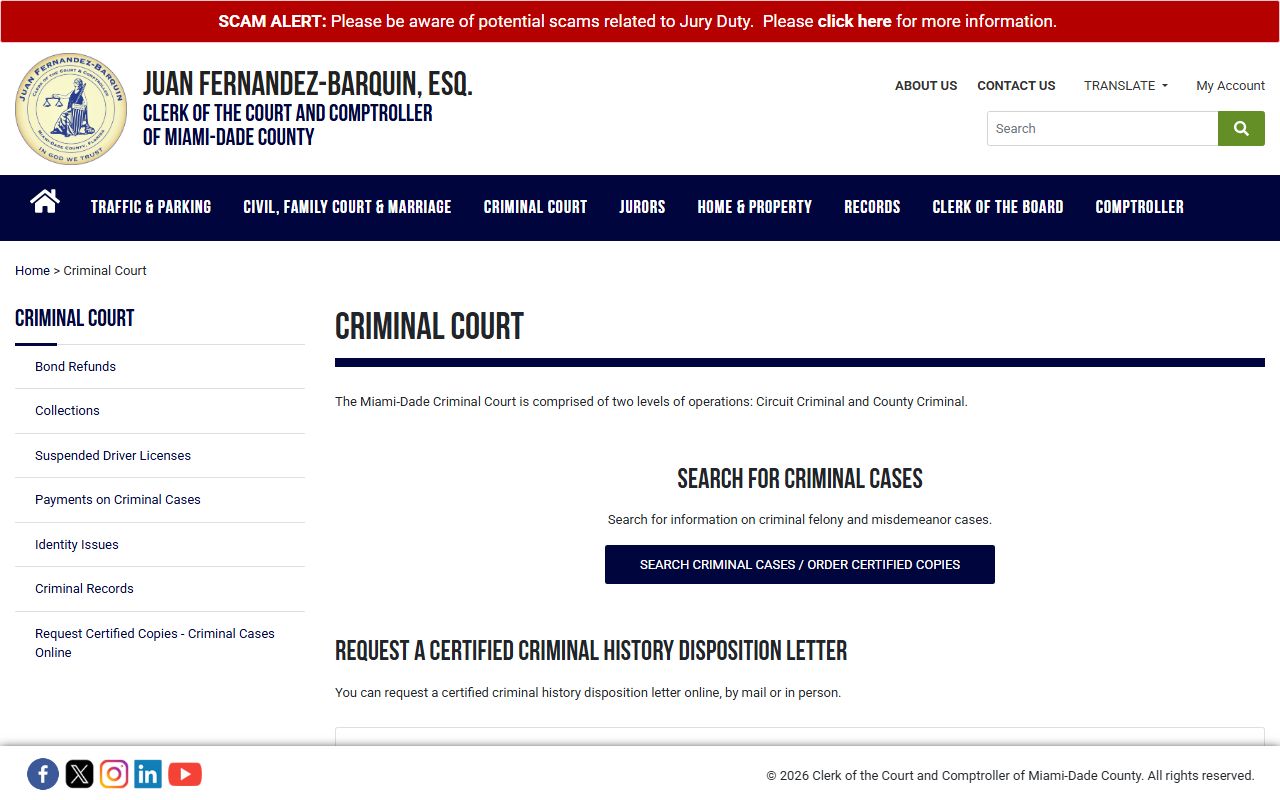
From that page the reader can move into either case-search portal and read the charges the prosecutor filed. The table below lists the search fields captured on the criminal portal.
| Field | Type | Required | Notes |
|---|---|---|---|
| Case Number | Text / dropdown | By mode | Case code, year, and six-digit sequence; year list runs 1925 to current. |
| State Case Number | Text fields | By mode | County ID, year, two-digit case code, and sequence. |
| Citation / Police Number | Text | By mode | Up to 15 characters. |
| Defendant First Name | Text | Yes (individual) | Required for an individual defendant search. |
| Defendant Last Name | Text | Yes (individual) | Required for an individual defendant search. |
| Defendant Sex | Dropdown | Yes (individual) | Female, Male, Unknown, or All the Above. |
| Date of Birth | Date | Optional | Used on the defendant and background-check paths. |
| Jail Number | Text / dropdown | By mode | Jail year plus a number up to seven characters. |
Miami-Dade County Court Case Search Portals
The two portals serve slightly different needs. The Universal Case Search is fast when you already hold a case or citation number. The Criminal Justice Online Case Search is the deeper tool, with name search, background-check paths, payment search, and the court calendars. Both carry the same Clerk warnings. The office tries to keep the data right but does not warrant that it is complete, accurate, or current, so the Clerk's office holds the official record.
Not every case shows online. Sealed, juvenile, adoption, and mental-health matters may or may not appear, since the Florida Supreme Court mandate and the Clerk's Access Security Matrix control what the public can view. A document image pulled from the portal is also not for official use. When you need an official copy, order a certified one from the Clerk.
The Universal Case Search portal is the quick route when you have a number in hand.
The Miami-Dade Clerk Universal Case Search takes a case or citation number and returns the matching court record.
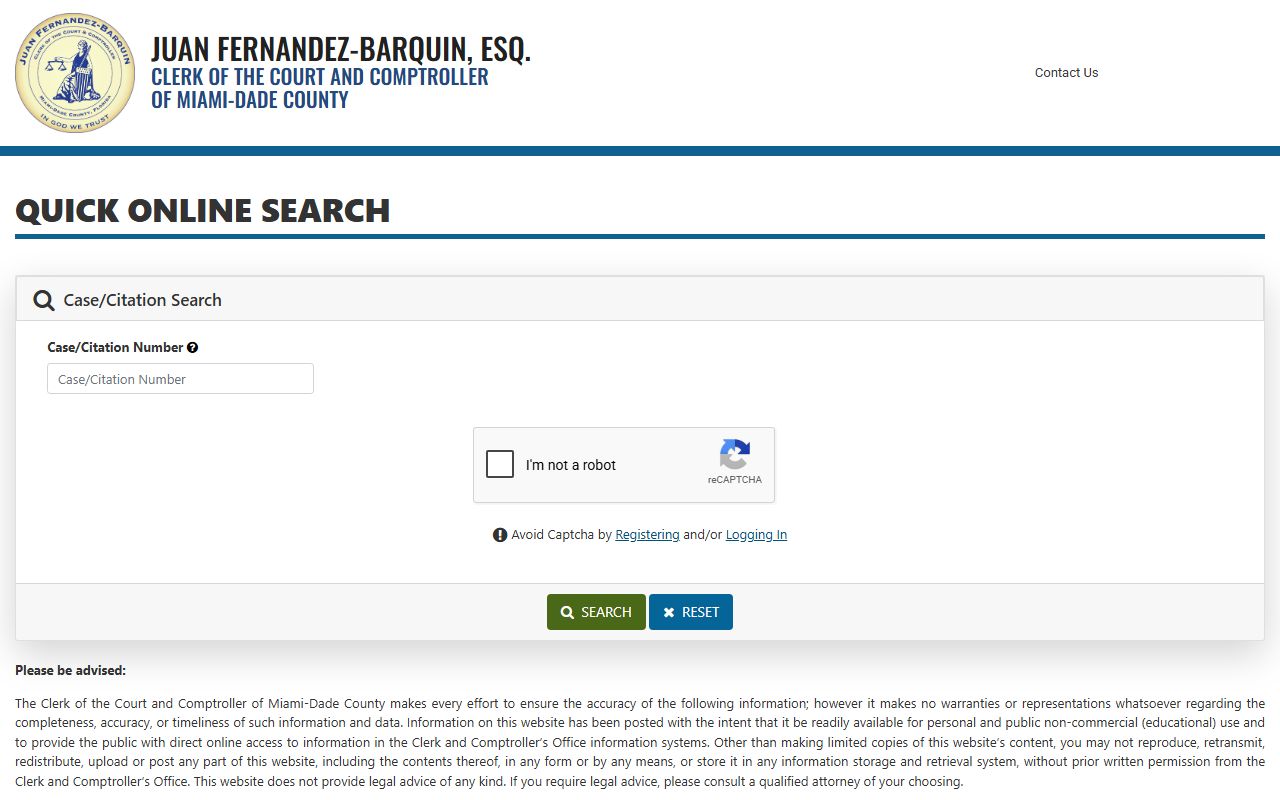
That lookup is handy once the prosecutor has filed and a case number exists. For a broader statewide check, the Florida Department of Corrections and the Florida Department of Law Enforcement hold prison and criminal-history data that reaches past one county.
Note: A public-access document image is not for official use, so order a certified copy from the Clerk whenever an official court record is required.
How Charges Get Filed After an Arrest: Complaint, Information, and Indictment
The court record opens when a charging document is filed. Booking at the jail comes first, but the case does not start until the prosecutor or a grand jury puts charges on paper. Florida uses a few document types. An information is the charging paper the prosecutor files directly. An indictment comes from a grand jury, a group of citizens who decide there is enough cause to charge a serious felony. A complaint or affidavit usually starts a misdemeanor. Circuit Criminal handles felony probable-cause affidavits, grand jury indictments, and arrest warrants, while County Criminal handles the misdemeanor side.
| Complaint | Information | Indictment | |
|---|---|---|---|
| Filed By | Officer / prosecutor | State Attorney | Grand jury |
| Common For | Misdemeanors | Many felonies | Serious felonies |
| Court Level | County Criminal | Circuit Criminal | Circuit Criminal |
| Starts | The case | The case | The case |
Charge Status in Miami-Dade County Court Records
Charges shift as a case moves through court, and the docket shows where each one stands. This matters because the charge logged at booking can differ from the charge the State Attorney finally files. The prosecutor can amend, reduce, add, or drop a charge after the arrest. A few status terms come up again and again in the case record.
| Status | What It Means |
|---|---|
| Pending | The charge is still active and the case has not closed. |
| Amended / Reduced | The charge was changed after filing, or lowered to a lesser offense. |
| Dismissed | The court or prosecutor ended the charge. |
| Nolle Prosequi | The prosecutor chose not to go forward with the charge. |
Two more terms close out a case. A disposition is the final court outcome on a charge. A conviction is a finding or plea of guilt, which is not the same thing as an arrest or a booking. Reading the status of each count tells you whether the matter is open, dropped, or decided.
Bond and Release After a Miami-Dade County Arrest
Bond is set early, often at a first appearance or bond hearing soon after booking. In Miami-Dade County, felony bond hearings run twice a day by video between the courtroom and the Pre-Trial Detention Center, on weekdays at 9 a.m. and 1:30 p.m. On weekends and holidays they run once a day, right after the morning misdemeanor jail arraignments at 9 a.m. Felony bond hearings sit in Courtroom 1-5 at the Richard E. Gerstein Justice Building, while misdemeanor jail arraignments are held in Courtroom 5-3 on weekdays at 9 a.m. and 1:30 p.m. The court calendar listing who is scheduled is posted right before each hearing.
If the charges are bondable, the person can post and get out. The county cannot recommend a bondsman. A bond amount does not promise release, though, because a hold can keep someone in custody.
| Bond Type | How It Works |
|---|---|
| Cash Bond | Money is paid directly to secure release; confirm the amount and process with the jail or court. |
| Surety Bond | A licensed bail agent posts the bond for a fee or collateral. |
| ROR / Recognizance | The court releases the person on a written promise, with no paid bond. |
| No-Bond Hold | The person stays in custody despite a charge, due to a detainer, warrant, or other hold. |
Note: A detainer is a request from another agency to keep a person in custody, and an immigration or out-of-county hold can block release even after bond is posted.
Warrants That Lead to a Miami-Dade County Arrest
Many arrests start with a warrant. An arrest warrant or a bench warrant is served, the person is taken to TGK for booking, and the roster then shows the custody facts. The court docket is the place to read the underlying case, the issuing court, the bond status, and the next hearing. Checking the case record matters because the warrant ties back to a court file.
The Miami-Dade Sheriff's Office Warrants Bureau is the local source for warrant operations. It serves felony warrants issued in the county and from jurisdictions nationwide, and runs a 24-hour desk that verifies warrants for officers. The Bureau sits at 9105 NW 25th St, Doral, FL 33172, and can be reached at 305-471-1700, with the general Sheriff line at 305-SHERIFF. A public name-search warrant portal for the county was not located, so phone contact or a court-docket check is the practical route. Statewide, the FDLE Wanted Persons search reaches beyond one county.
Charges vs. Convictions
Being arrested and charged is not the same as being found guilty. A charge is an accusation, and a court record that shows a charge does not prove a conviction. Many charges end in a dismissal, a nolle prosequi, or a not-guilty result. The gap between the two stages matters for anyone reading a record, because the early charge and the final outcome can differ a lot.
| Charge | Conviction | |
|---|---|---|
| Stage | Accusation at filing | Verdict or plea of guilt |
| Burden of Proof | Probable cause | Beyond a reasonable doubt |
| Decided By | Prosecutor's filing | Judge or jury |
| Public Record | Yes | Yes |
Sealed vs. Expunged Arrest Records
Florida law lets some people clear a record after an arrest, but the two routes differ. Sealing falls under Florida Statute 943.059 and hides a record from routine public view. Expunction falls under 943.0585 and goes further, ordering most agencies to destroy their copies. Both start with a Certificate of Eligibility from the Florida Department of Law Enforcement, which charges a $75 fee and issues a certificate that is good for 12 months. The relief is discretionary, so a judge may grant or deny it.
| Sealed | Expunged | |
|---|---|---|
| Statute | 943.059 | 943.0585 |
| Public Access | Hidden from routine view | Destroyed; treated as if it never existed |
| Who Can Still See It | Subject, attorney, and listed criminal justice or licensing entities | Only by court order |
| Typical Path | FDLE certificate, then court petition | State Attorney completes Section B, then FDLE and court |
The Miami SAO Second Chance Program helps people seek these orders for certain low-level cases that did not end in conviction. When charges were dropped, the State Attorney completes Section B of the expunge application at no fee. To start, print the FDLE form or call the FDLE Expunge Section at 850-410-7870, get a certified disposition from the Clerk, complete a fingerprint card, and mail the packet with the $75 fee to FDLE, PO Box 1489, Tallahassee, FL 32302-1489. Only state cases that happened in Miami-Dade County qualify for the program.
Background Check Considerations
The Clerk's Background Check path and certified disposition letters serve a real records purpose, but they are not the same as a regulated screening. A certified disposition letter gives the results of a local case search for felony and misdemeanor cases. Certified copies cost $7, and if the year or case number is unknown, the search adds $2 per year, per name. Felony requests go by mail to the Miami-Dade County Criminal Division, Richard E. Gerstein Justice Building, 1351 NW 12th St, Suite 9000, Miami, FL 33125, with misdemeanor requests at Suite 8100 and traffic at Suite 124.
Important: Miami-Dade County Inmate Population is not a consumer reporting agency under the FCRA, and its data may not be used for employment, credit, housing, or insurance screening.
Restricted Court Records After an Arrest in Miami-Dade County
Not every court record after an arrest is open to the public. Florida Chapter 119 keeps most agency records open, yet several clear exemptions apply. Juvenile cases, sealed and expunged records, and active investigations may be withheld in whole or in part. The Clerk's Access Security Matrix sets what the public can view online, which is why some matters never load in the portals.
For older or unavailable files, a public-records request to the Clerk can pull a court file the portal does not show. When the record is needed for official use, a certified copy from the Clerk is the right form, since a public-access document image carries a notice that it is not for official use. Federal charges follow a separate track. Those cases run through the U.S. Attorney's Office for the Southern District of Florida at 99 N.E. 4th Street, Miami, FL 33132, reachable at 305-961-9001, and are searched through the federal system, not the county Clerk.