
Who Runs the Miami-Dade County Jail Roster
The Miami-Dade Corrections and Rehabilitation Department, known as MDCR, runs the local jails. It calls itself one of the largest correctional systems in the country. MDCR holds people awaiting trial and people serving sentences of 364 days or less. The department, not the Sheriff's Office, owns the inmate roster, visitation, deposits, release, and corrections records. Sherea Green serves as the MDCR director. The Miami-Dade Sheriff's Office handles warrants and some law-enforcement records, but it does not run the jail roster. So custody questions go to MDCR, while warrant questions go to the Sheriff's Office.
The MDCR inmate search lists people in current custody. Its FAQ says the search also shows people released within the last 72 hours. That short window matters. A person let out days ago may no longer appear, even though records still exist. The roster does not cover everyone. Sentenced state felons move to the Florida Department of Corrections (FDC). Federal defendants land in Bureau of Prisons or U.S. Marshals custody. People on an immigration hold sit in ICE custody. Each group needs its own locator, covered further down.
How to Use the Miami-Dade County Inmate Roster
The roster is free and needs no login. You only need part of a name to start. Open the official MDCR inmate search and work through the steps below. The county explains the public search on its inmate in-custody service page.
- Open the MDCR inmate search page.
- Type at least three letters of the last name. The county instruction asks for a last name with a first initial or first name.
- Type at least three letters in the first name field, since the form enforces a three-character minimum there too. Use the first few known letters if the spelling is unsure.
- Select the "Search »" button.
- Read the results grid for name, date of birth, race, sex, location, charges, bond amount, jail number, booking date and time, and mugshot.
- If no one shows, check timing and custody type. A new arrestee may still be in booking. A sentenced felon may have moved to FDC. A federal or ICE case uses a different system.
The lookup tool itself is plain. The county's own screenshot shows the two name fields and the search button on the MDCR inmate search.
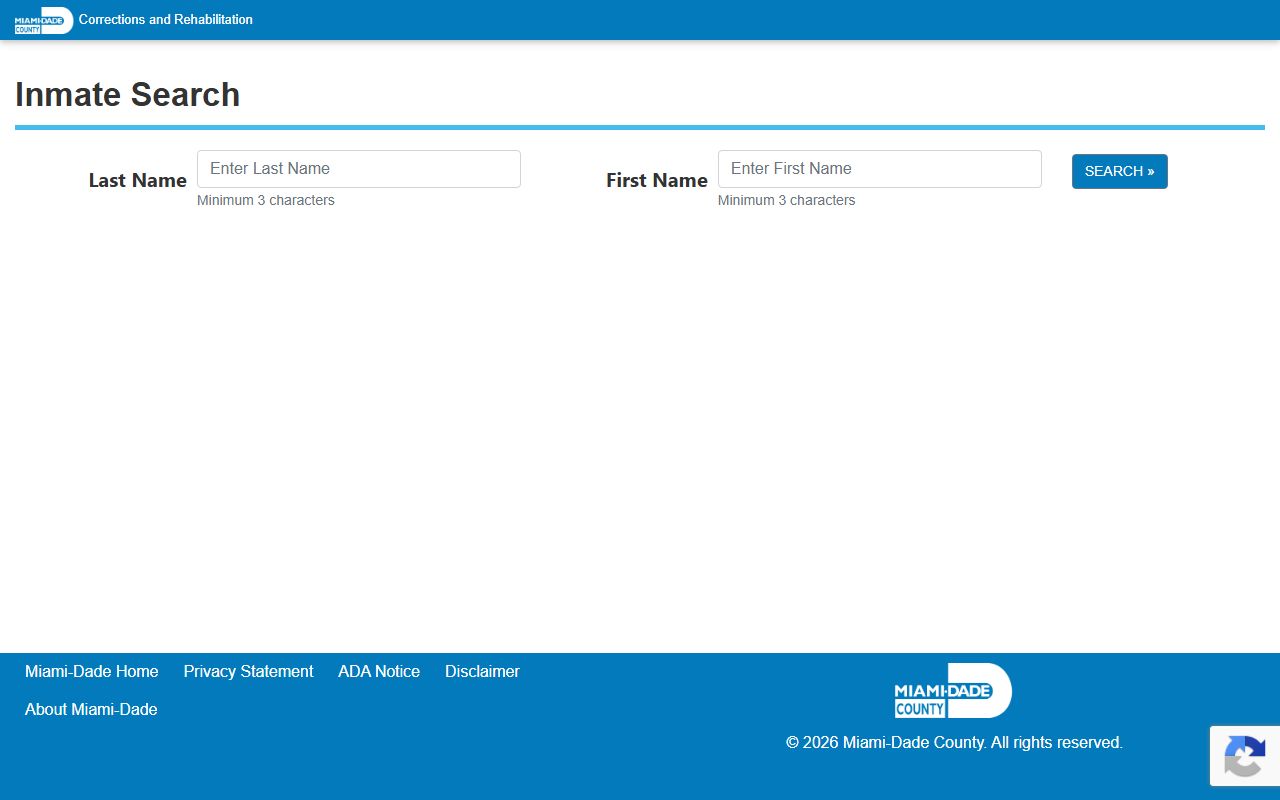
That image makes the limits clear. There is no booking-number box, no date-of-birth box, and no facility menu to guide your search.
Miami-Dade County Roster Search Fields
The public form is short on purpose. It exposes only two text fields plus a button. Each name field shows the prompt "Minimum 3 characters." The county service page says you may enter a last name with a first initial or a full first name. The table below lists exactly what the live form accepts.
| Field Label | Type | Required | Notes |
|---|---|---|---|
| Last Name | Text | Yes | Prompt reads "Enter Last Name"; minimum three characters. |
| First Name | Text | Yes | Prompt reads "Enter First Name"; minimum three characters; first initial or first name per county text. |
| Search » | Submit button | n/a | Runs the search and opens the results grid. |
Note what is missing. The public form has no booking-number field, no date-of-birth field, no facility dropdown, and no current-versus-released tab in the captured page. You search by name, then read the grid. The FAQ adds that one search covers both current inmates and those released in the past 72 hours.
Note: A common code in the Location column is NDCCC, which means the person is on house arrest with an ankle monitor, not in a jail; North Dade Community Correctional Center is closed.
What a Miami-Dade County Inmate Record Shows
A roster result is a snapshot of custody data, not a full case file. The county lists the exact fields a search returns. Charges shown here are booking charges and can differ from the formal charges a prosecutor later files. The bond amount appears when the charge is bondable. The jail number is the key value for mail, deposits, and court searches. The table below explains each field in plain terms.
| Field | What It Shows |
|---|---|
| Name | The person's name in MDCR custody or search results. |
| Date of Birth | The birth date, which helps tell apart people who share a name. |
| Race | Race as listed in MDCR case data. |
| Sex | Sex listed on the inmate result. |
| Location | Facility or location code. NDCCC means house arrest with an ankle monitor, not jail custody, since North Dade Community Correctional Center is closed. |
| Charges | Booking charges shown by MDCR. These may differ from the court charges the State Attorney files later. |
| Bond Amount | Bond set when the charge is bondable. Call inmate information if it is unclear. |
| Jail Number | The MDCR ID used for mail, deposits, records requests, and jail-number court searches. |
| Booking Date | The date the person was entered into MDCR custody. |
| Booking Time | The time of booking. |
| Mugshot | The booking photo shown on the result per the county service page. |
The county spells out these same fields in its own write-up of the search. You can see that field list on the inmate in-custody service page.
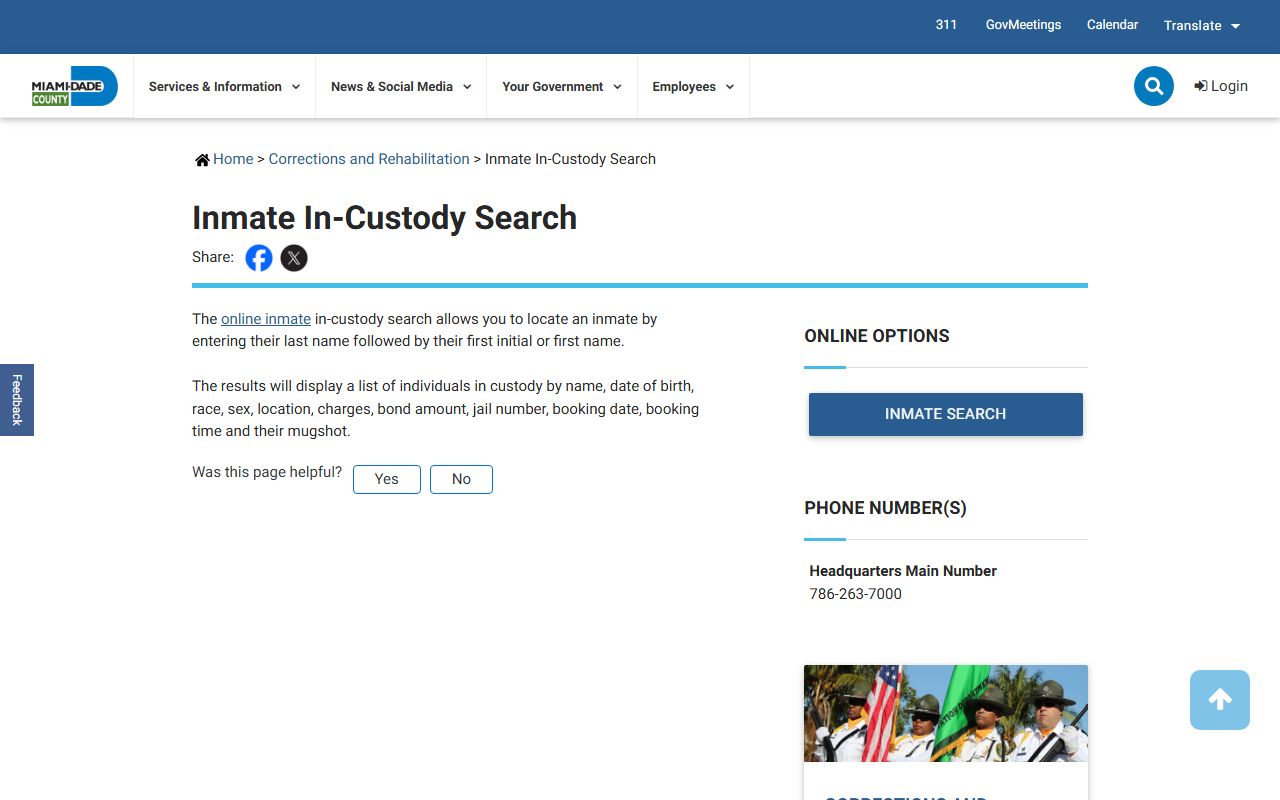
That page is useful when a result looks thin. It explains why a fresh booking may show a charge but no bond amount yet. For booking photos in more depth, the Miami-Dade County jail mugshots page covers what is and is not public.
Finding Miami-Dade County, State, and Federal Inmates
This is where searches go wrong. The MDCR roster covers county jail custody, mainly pre-trial detainees and people serving short sentences. Pre-trial means held while a case is still open, before any conviction. Once a person is sentenced to state prison, the search shifts to FDC. Federal cases use the Bureau of Prisons (BOP) locator, and immigration holds use ICE. A detainer is a hold one agency places asking another to keep a person in custody. The table sorts out where each type of inmate appears.
| Custody | Where to Look |
|---|---|
| Pre-trial or short county sentence | MDCR inmate search |
| Sentenced state felon | Florida Department of Corrections (FDC) Offender Search |
| Federal inmate | Federal Bureau of Prisons locator |
| Immigration hold | ICE Online Detainee Locator |
| Release notification | VINELink |
The FDC search holds public records on felony offenders sentenced to state prison. It refreshes the full population weekly, with release dates and location changes updated nightly. It does not include people held in county jail or on county probation. The BOP locator covers federal inmates from 1982 to the present. A BOP result of "Released" or "Not in BOP Custody" can mean the person moved to another system, parole, or supervised release.
The ICE Online Detainee Locator System finds people in ICE custody, or in CBP custody for more than 48 hours. You search by a nine-digit A-Number plus country of birth, or by exact first and last name and country of birth. It cannot search records for anyone under 18. VINELink offers custody and release notifications across systems; the Florida VINE line is 1-877-846-3435 and runs 24 hours a day. VINELink does not replace any of the four locators above.
Note: A booking may take several hours, so a very recent arrest can show a charge with no bond amount yet while staff finish intake at the main jail.
Why Someone May Not Appear on the Roster
A blank result rarely means no custody. Timing and custody type explain most misses. Several common reasons sit behind an empty search.
- Just arrested and still being processed at the main jail, so the record is not complete.
- Released more than 72 hours ago, which is past the window the search shows.
- Sentenced and moved to Florida Department of Corrections custody.
- Held as a federal defendant in Bureau of Prisons or U.S. Marshals custody.
- Held on an immigration matter in ICE custody.
When the timing is fresh, the fix is a phone call rather than a guess. The next section lists the right MDCR numbers. When the custody type has changed, switch to the matching locator from the table above.
Contact the Miami-Dade County Jail
When the roster is down or a record looks incomplete, a phone call often works. Turner Guilford Knight Correctional Center is the central intake and release point. The county also runs Metro West Detention Center as a large housing facility. Both contact cards appear below, with the main numbers from MDCR.
Turner Guilford Knight Correctional Center
7000 NW 41st St
Miami, FL 33166
786-263-5341
Information Desk: 786-263-5550
Metro West Detention Center
13850 NW 41st St
Miami, FL 33178
786-263-5110
MDCR county detention facility
Several MDCR lines help when the roster falls short. The main department number is 786-263-7000. For booking questions, call 786-263-5312. For intake, call 786-263-5305. Inmate Records is 786-263-4222, and Release is 786-263-5360. The TGK Information Desk at 786-263-5550 handles inmate location, bond, and visiting questions. The county also posts these numbers on its MDCR contact page.
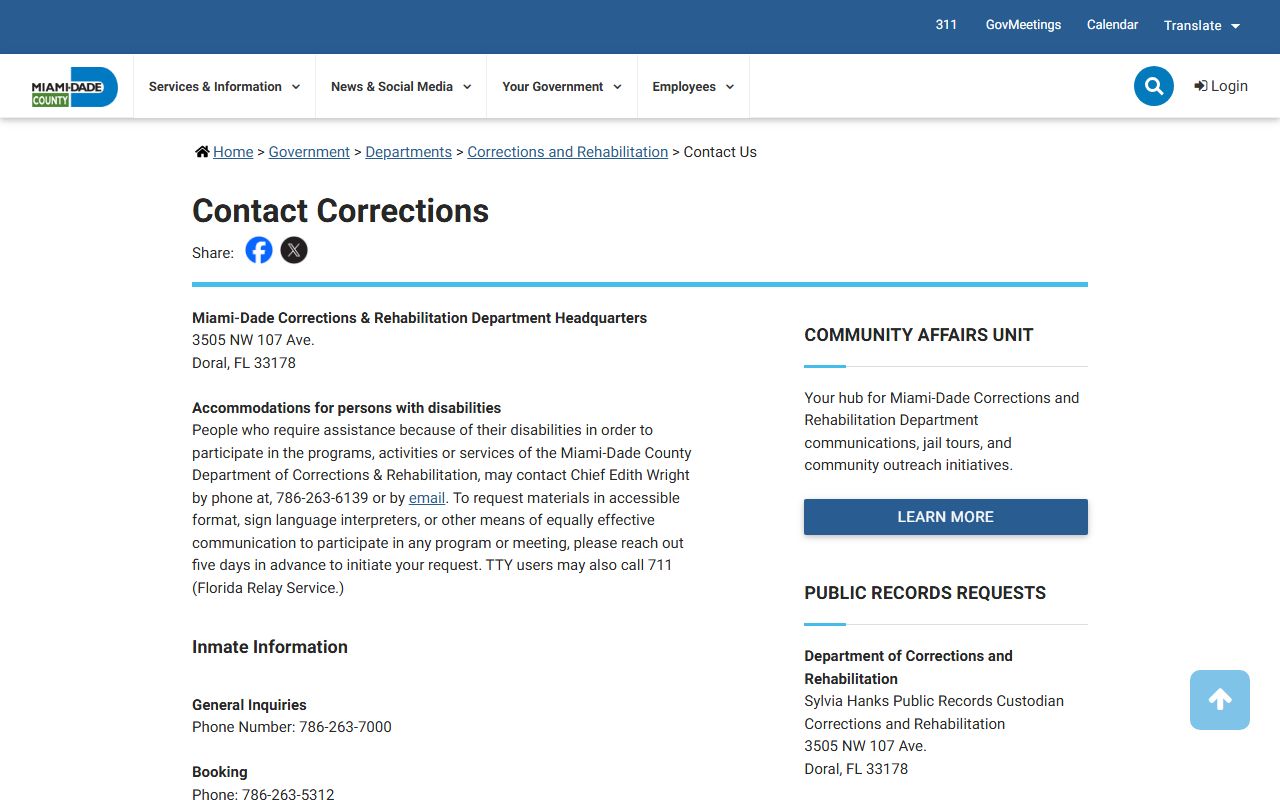
That page is the safest source for current numbers, since extensions can change. It also lists the public-records custodian for corrections records.
Requesting Miami-Dade County Corrections Records
Some records are not online at all. Older bookings, full booking files, and other corrections records go through a public-records request. Miami-Dade County uses a tool called GovQA. You can create an account, log in, or submit anonymously, though anonymous users do not get email updates and must track by reference number. A request should name the inmate, the jail number if known, the booking date, and the exact record sought. Arrest reports written by police belong to the law-enforcement agency, not MDCR, so route those to the Sheriff or arresting agency.
Copy fees are set by the county. The table below lists the main Central Records fees.
| Item | Fee |
|---|---|
| Single-sided page | $0.15 |
| Double-sided page | $0.20 |
| Certified copy | $1.00 per page |
| Color copy | $1.00 per page |
| Video or CD | $1.00 per disk |
A service charge can apply when research or processing runs more than 20 minutes, and partial payment may be required up front. Checks or money orders are made out to the Miami-Dade Corrections and Rehabilitation Department, Central Records Unit. Start a request through the corrections records service page or the GovQA Public Records Center.
Miami-Dade County Jail Visitation and Setup
MDCR offers remote video visitation as its standard service. The vendor is GTL, reached through the portal at miamidade.gtlvisitme.com. Friends and family cannot just show up. The inmate must place each visitor on the Approved Master Visitation List first. After that, the visitor registers and creates a GTL account, then allows up to 24 hours for processing. Visitation questions go to 786-263-4119. Because the system is setup-driven, the table below shows the path by visitor type rather than a fixed day grid.
| Visitor Type | Approval and Setup | Processing or Contact |
|---|---|---|
| Friends and family | Inmate must add the visitor to the Approved Master Visitation List, then register with GTL | Allow up to 24 hours; questions 786-263-4119 |
| Attorneys | Complete the attorney remote video visitation form and register with GTL | Follow MDCR attorney instructions |
| Professional visitors | Complete the professional visitor application and register with GTL | Follow MDCR professional visitor instructions |
The full rules and forms sit on the MDCR visitation page. Confirm a person is in custody before you set up a visit, since the roster covers only current and very recently released inmates.
How to Contact a Miami-Dade County Inmate
Mail follows strict county rules. All mail must be sent by USPS and addressed to the inmate. Mail from other couriers is refused. Only plain white, originally lined paper is allowed for personal letters. The county routes incoming mail through a central digital mail center in Tampa, not to the jail itself. Use this format on the envelope and letter.
- Inmate full name and jail number
- Miami-Dade Corrections and Rehabilitation Department
- PO Box 20527
- Tampa, FL 33622
Many items are banned, including hardcover and paperback books, magazines, greeting cards, postcards, colored paper, stamps, stickers, and padded mailers. The return address must list the sender's first and last name and full address. Phone and messaging run through Securus. Inmates cannot receive calls, so families set up prepaid collect calling with Securus AdvancePay or AdvanceConnect. Deposits can be made on the Securus website, app, or by phone, and customer service is 1-800-844-6591. The eMessaging service is monitored, and rejected messages or photos do not get a stamp refund.
Commissary and Inmate Funds
Two systems handle money for an inmate. Commissary gifts run through iCare. To send items, open iCare, choose Find an Inmate or Start Shopping, pick Florida, and search by last name or inmate number. Add items, check out, and submit payment. Questions about iCare go to 888-439-5020. Trust account deposits, which put money on the inmate's account, run through TouchPay. Online and phone deposits need the MDCR facility number 233101 plus the inmate name and jail number. The TouchPay phone line is 1-866-232-1899, and cash deposits go to a lobby kiosk.
Lobby kiosks at the jails take cash, credit, and debit. Kiosk hours vary by facility and shift, so check the posted schedule before you drive over. The court side of a case lives elsewhere; filed charges and court dates appear in the Miami-Dade County court records after a jail arrest resources rather than on the jail roster.
Note: Confirm custody status with MDCR before you send money or schedule a visit, because a person released or moved to another system may no longer be reachable through the county.