
Miami-Dade County Jail Mugshots Overview
The county jail roster does show a mugshot. The Miami-Dade Corrections and Rehabilitation Department, known as MDCR, runs the jail system and the public inmate search. MDCR is a county corrections agency, not a sheriff jail division. Its service page explains that each in-custody result lists a booking photo next to the person's name, date of birth, race, sex, location, charges, bond amount, jail number, booking date, and booking time. So the photo is part of the live roster record, not a stand-alone gallery.
Other places do not work the same way. The county Daily Jail Population report lists names, jail numbers, and offense text for the longest-stay inmates, but it carries no photos. The Sheriff's Office Warrants Bureau page explains warrant work and does not post a public mugshot gallery. There is no official Miami-Dade County historical mugshot archive that lets you browse old booking photos by name. Booking photos and charges are arrest-stage records. They do not prove that a person was convicted of anything.
Where to Find Miami-Dade County Booking Photos
The main place to find a current Miami-Dade County booking photo is the MDCR inmate search. It is free and needs no login. The form has just two text boxes, Last Name and First Name, each with a three-character minimum. Once results load, the grid shows the photo and the booking data for each person in custody. The county FAQ notes the search also lists people released within the last 72 hours, so a recently freed person may still appear. If the photo is no longer online, the records-request route and the inmate information phone line are the fallbacks.
- Open the MDCR inmate search page and read the on-screen instructions for the name fields.
- Type at least three letters of the last name, then add the first name or first initial in the second box.
- Select Search, then open the matching result to view the booking photo, charges, bond, jail number, and booking date and time.
- If the person or the photo is not online, note the booking date and jail number and file a records request with MDCR Central Records for the booking photo.
A blank result does not always mean no custody. A very new arrestee may still be in processing at the intake jail. A sentenced felon may have moved to state prison custody. A federal or immigration case routes to other systems covered further down. The county service page spells out the result fields and confirms that a mugshot is among them.
What a Miami-Dade County Booking Photo Shows
The photo never stands alone. MDCR publishes it beside a short set of booking and demographic fields, so one result both shows the face and tells the basic story of the booking. The table below highlights the photo field and lists the data the county says appears with it. The charge text is the booking charge, which can differ from the formal charge a prosecutor later files in court.
Below is a lead-in to how the county itself describes a result. The image links to the official explanation of what the search returns.
The county's own inmate in-custody service page describes the fields shown with each booking record.
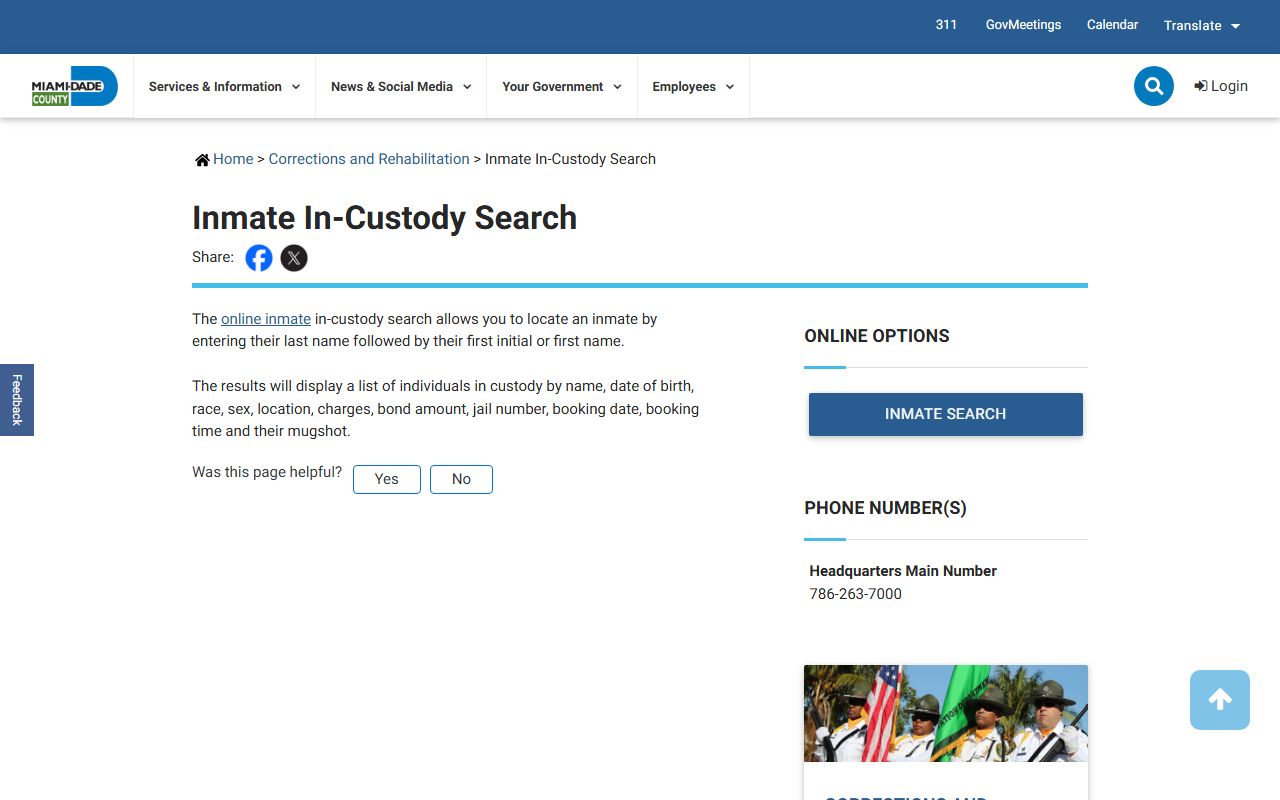
That page confirms a mugshot rides along with the name, demographics, charges, bond, and booking date and time, which is why one search returns both the picture and the facts behind it.
| Field | What It Shows |
|---|---|
| Booking Photo | The mugshot taken during intake at the jail; the county lists one photo per in-custody result and does not publish multiple angles or prior photos. |
| Name | The person's name as it appears in MDCR custody and search results. |
| Demographics | Date of birth, race, and sex; the date of birth helps tell apart two people who share a name. |
| Booking Date | The date the person was entered into MDCR custody, with the booking time also shown. |
| Charges | The booking charge text from the arrest; this may differ from the charge the State Attorney later files. |
Note: A result also shows the jail number and the bond amount, and the location field may read NDCCC when a person is on house arrest rather than in a jail.
Are Miami-Dade County Jail Mugshots Public Record?
In short, yes, with limits. Florida's public records law treats records held by a public agency as open unless a specific exemption applies. A booking photo held by a jail or police agency is generally a public record under that rule. That is why MDCR can show one on the roster and why you can request one in writing. The open door is not absolute, though. Sealed and expunged records, juvenile data, victim details, medical and mental-health notes, and active investigative files can all be withheld or restricted by law.
Florida also has a statute aimed at companies that publish booking photos online. It gives a person a written-request path to have such a published photo taken down. That law targets the publishers, not the government file. It does not force a jail to erase a record it lawfully holds. The two statutes below set the frame for both sides of the question.
Key Statutes:
Florida Statutes Chapter 119 - The state public records law that keeps agency records, including most booking photos, open to the public unless a clear exemption applies.
Florida Statutes § 901.43 - Sets a written-request process to have a published arrest booking photo removed by the publisher and adds penalties for those that refuse.
How Long a Mugshot Stays on the Roster
The photo stays tied to the live custody record. While a person is in MDCR custody, the booking photo shows on the search result. The county FAQ adds that the inmate search also lists people released within the last 72 hours, so a freed person can still turn up for a short window. The county does not state a separate, fixed shelf life just for the photo, and it does not run a public archive of older mugshots. Once a person drops off the live search, the photo is no longer browsable there.
What is and isn't public: The public can view the booking photo, name, demographics, charges, bond, jail number, and booking date and time for people in MDCR custody, plus those released within the last 72 hours. Older booking photos are not posted in a public gallery and must be sought through a records request. Sealed, expunged, juvenile, victim, medical, and active-investigation details are restricted by Florida law and will not show on the roster.
Note: Because the roster only carries current and very recent records, a missing photo often means timing, not error, so a records request is the route to an older booking image.
How to Request a Miami-Dade County Booking Photo
When a booking photo is not on the roster, the formal path is a public-records request. Miami-Dade County uses an online tool called GovQA. You can create an account or submit a request without one, though an anonymous request gets no email status updates. MDCR Central Records handles corrections records. The request should name the person, the date of birth if known, the jail number, the booking date, and the arresting agency if you have it. Clear identifiers help staff find the right record faster.
Match the request to the right office. A corrections booking record goes to MDCR through the county GovQA public records center or the Central Records service page. If the photo is part of a law-enforcement arrest report instead of a corrections record, send the request to the arresting police or Sheriff's Office agency. MDCR Central Records charges copy fees, and a service charge can apply when research takes more than 20 minutes. If a record is sealed or expunged, include the court order and ask how it applies to public copies.
Note: An anonymous GovQA request still works, but you must track it by reference number because the system will not email you updates about its progress.
Mugshot Removal and Sealed Records
People often ask how to get a booking photo taken down. For an official county or state record, there is no simple delete button. The formal routes are sealing and expunction. Sealing restricts a record from routine public access. Expunction orders the record removed or destroyed from routine public access. Both are court-ordered under Florida law and follow eligibility rules. A dismissal or a not-guilty result does not erase a record on its own; the court order is what restricts it.
Florida Statutes § 901.43 applies to commercial websites that publish booking photos. It lets a person send a registered-mail request to the site's registered agent and requires removal within 10 days at no charge, with civil penalties for sites that refuse. That law deals with publishers, not the government file. To restrict the underlying official record, the routes are court-ordered sealing and court-ordered expunction. The steps for those court orders are covered on the page about sealing and expunging an arrest record.
Federal and State Booking Photos
Not every custody system posts a booking photo. The county roster is for people in MDCR jail custody. Once a person is sentenced to state prison, the lookup shifts to the Florida Department of Corrections offender search. FDC says its state prison profiles do include photographs, though that photo is separate from any MDCR mugshot and lives in a different system. So a state prisoner's picture appears in the FDC locator, not on the county jail roster.
Federal and immigration custody work differently again. The Federal Bureau of Prisons inmate locator returns identifiers like name, register number, age, race, sex, release date, and location, but it does not publish a public mugshot gallery. The U.S. Marshals Service limits public release of prisoner photos. The ICE Online Detainee Locator System finds where an immigration detainee is held; it is a location tool, not a mugshot search. For current booking photos and roster details on county arrests, the starting point stays the Miami-Dade County jail records search.