
Federal Detention Center Miami Overview
The Federal Detention Center Miami (FDC Miami) is an administrative-security Bureau of Prisons facility located in downtown Miami at 33 NE 4th Street, Miami, FL 33132. Administrative-security is the BOP's designation for facilities that house special management populations, including federal pretrial detainees who have not yet been convicted of any offense, holdover inmates temporarily assigned while in transit between facilities, and sentenced inmates with specialized needs. The facility serves the Southern District of Florida, one of the busiest federal judicial districts in the United States, and it holds both male and female federal detainees and inmates.
A note about initials: the facility is commonly abbreviated as "FDC Miami," but "FDC" in this context stands for Federal Detention Center. The Florida Department of Corrections, the state agency that oversees Florida's state prison system, is a separate entity that also uses the abbreviation "FDC." These two systems have no connection to each other. Someone held at the Federal Detention Center Miami is in federal Bureau of Prisons custody. Someone sentenced to a Florida state prison would be in the custody of the Florida Department of Corrections and would be found through the FDC Offender Search, not through the BOP Inmate Locator. Both systems are separate from the Miami-Dade county jail operated by Miami-Dade Corrections and Rehabilitation Department.
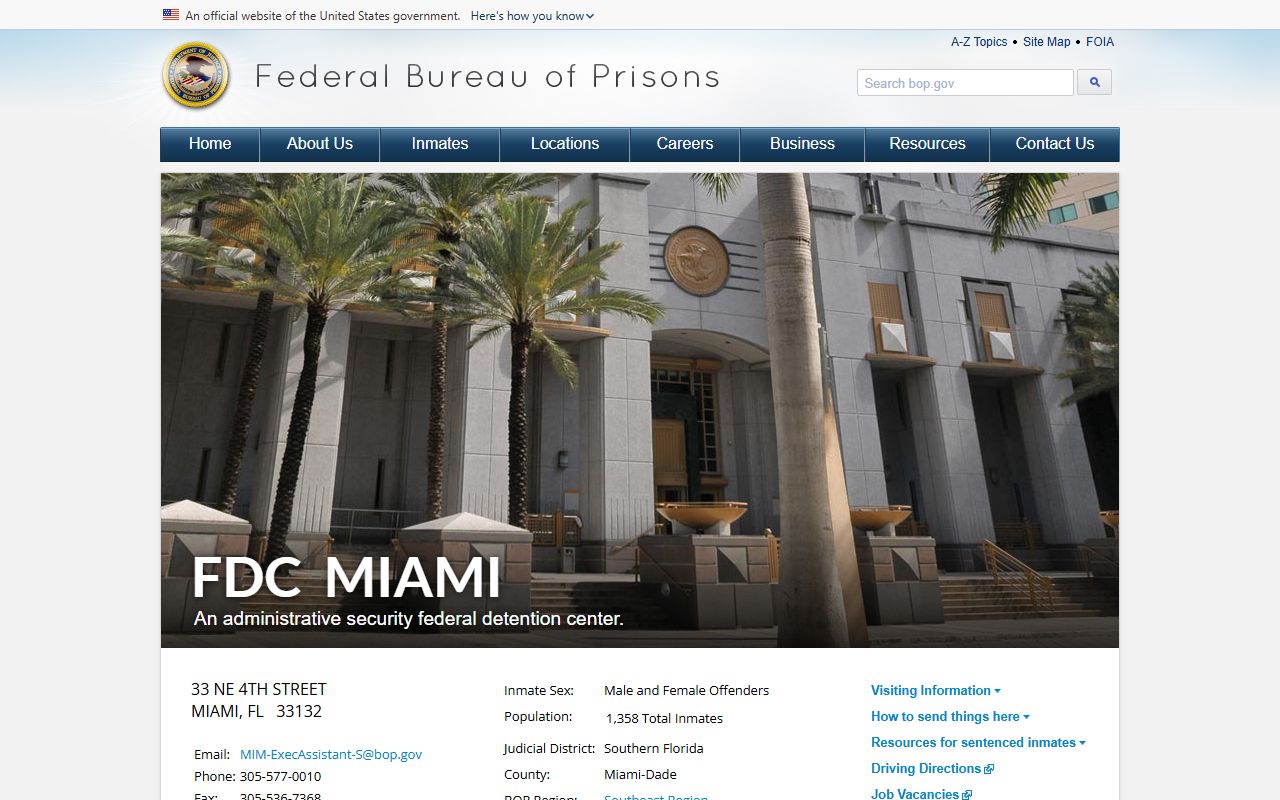
The BOP facility page for FDC Miami includes the official visiting regulations, mail addresses, phone and money deposit procedures, commissary information, legal access resources, and PREA report links for the facility.
FDC Miami Population and Capacity
The Bureau of Prisons publishes population data for its facilities through a public API. As of May 28, 2026, the Federal Detention Center Miami held 1,358 people. A rated capacity figure for FDC Miami was not located in publicly available BOP sources during the research for this page. Administrative-security facilities like FDC Miami house populations that can shift rapidly as federal cases proceed through the courts, as people are sentenced and transferred to other BOP institutions, or as in-transit populations move through. The 1,358 figure below reflects the BOP population data for May 28, 2026 and will not match the count at other points in time.
Federal detention center populations are distinct from county jail populations even when both numbers are associated with the same geographic area. FDC Miami's 1,358 people as of May 28, 2026 are in BOP federal custody, not in Miami-Dade county custody. The county jail system operated by Miami-Dade Corrections and Rehabilitation Department reported 4,788 people in county custody on the same date. These are separate systems that serve different legal purposes, hold people under different legal standards, and are searched through different locator tools.
How to Look Up an Inmate at Federal Detention Center Miami
The BOP Inmate Locator is the correct and only public tool for finding someone held at FDC Miami. The MDCR inmate search at miamidade.gov covers only people in Miami-Dade county jail custody. The Florida Department of Corrections Offender Search covers only people in Florida state prison custody. Neither covers federal detainees or inmates at BOP facilities. The BOP Inmate Locator covers federal inmates from 1982 to the present and can search by several number types or by name.
- Open the BOP Inmate Locator at bop.gov/inmateloc/.
- Select "Find By Number" if you have a BOP Register Number (formatted as five digits, a hyphen, then three digits), a DCDC Number, an FBI Number, or an INS Number. A BOP Register Number (also called a federal register number) is the primary identifier assigned when someone enters BOP custody. Select "Find By Name" if you have only the person's name, and use optional fields like race, age, and sex to narrow a common name search.
- Submit the search and review the results table. Results show the person's name, register number, age, race, sex, projected release date, and facility.
- Confirm the listed facility is Federal Detention Center Miami. If the result shows a different facility, the person may have been transferred after court proceedings. If the result shows "Released" or "Not in BOP Custody," the person may have completed a federal sentence, been acquitted, or moved to a different system such as state custody or supervised release.
There are no public mugshot galleries for federal detainees or inmates at FDC Miami. The BOP Inmate Locator returns location and identifier information, not booking photographs. This differs from the Miami-Dade county jail roster, which the county describes as including booking photos in its results. Federal facilities do not publish publicly browsable mugshot galleries, and looking for booking-style photos through the BOP Inmate Locator will not return them.
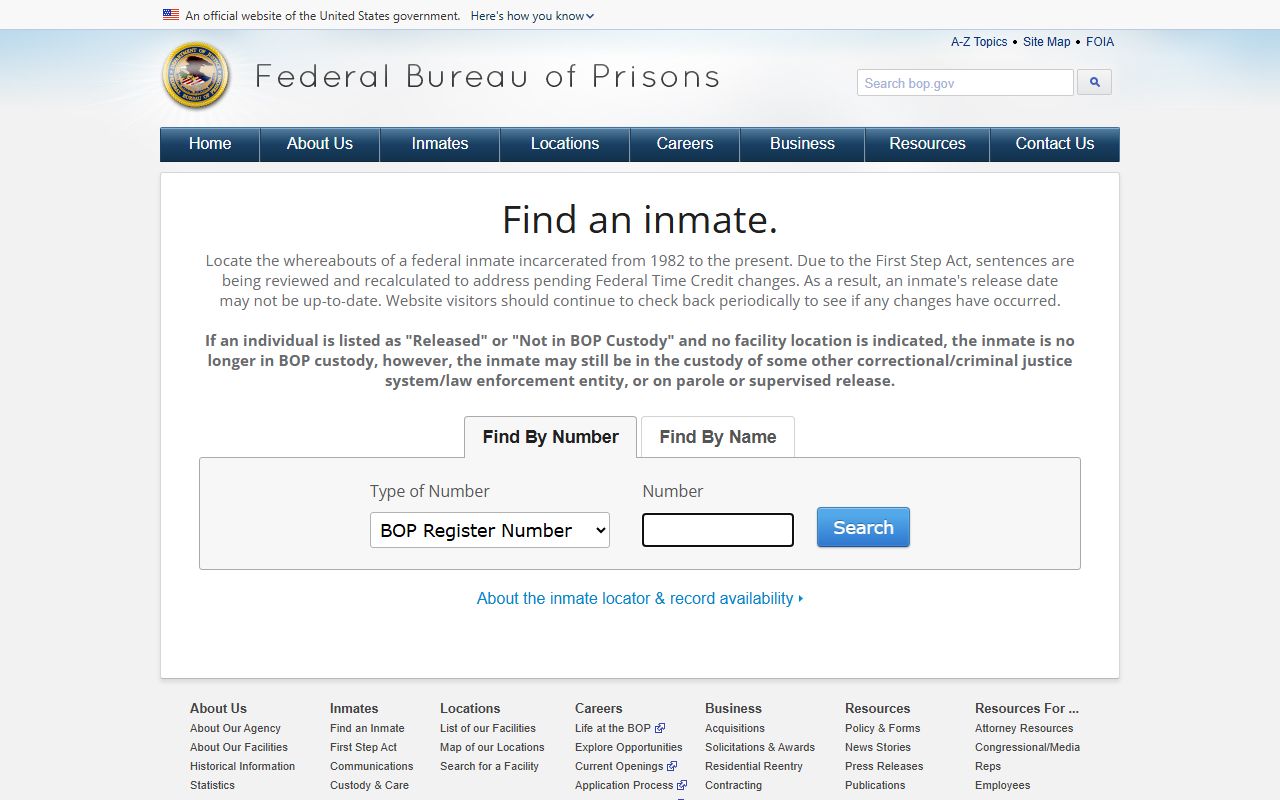
The BOP Inmate Locator searches all BOP facilities by number or name and returns the inmate's current facility assignment, register number, age, race, sex, and projected release date.
For background on how county, state, and federal custody systems differ in Miami-Dade, see the Jail Inmate Records page, which explains which locator applies to which type of custody.
Who Federal Detention Center Miami Holds
FDC Miami holds several distinct populations within its administrative-security designation. Understanding these categories helps families and attorneys determine whether someone should appear in the BOP Inmate Locator or through a different channel, and what legal process applies to the person's situation.
- Federal pretrial detainees
- People who have been charged with a federal offense in U.S. District Court and ordered into custody by a federal magistrate or district judge, but who have not yet been convicted or sentenced. They are held at FDC Miami while their cases proceed through the Southern District of Florida. Being held pretrial does not mean the person has been found guilty of anything.
- Holdovers
- Federal inmates who are temporarily at FDC Miami because they are between permanent assignments. This may happen when an inmate is in transit between institutions or is waiting to be transported to a court proceeding in another jurisdiction.
- In-transit inmates
- People moving through the federal system between court appearances, between BOP facilities, or after a transfer order. Their time at FDC Miami may be brief, and they may appear and disappear from the locator relatively quickly.
- Administrative-security cases
- Some sentenced federal inmates with specialized security or management needs may be designated to administrative-security facilities like FDC Miami rather than to a standard penitentiary or correctional institution.
The U.S. Marshals Service is responsible for the custody and transport of federal prisoners from the time a court orders them into custody until they are delivered to a BOP facility or acquitted. During that pretrial and transport phase, the BOP Inmate Locator may show FDC Miami as the assigned facility, though the USMS manages day-to-day logistics for pretrial detainees.
Note: Federal pretrial custody is civil in nature in terms of the presumption of innocence; a detainee at FDC Miami has not been convicted unless the BOP result shows a sentence in progress.
Federal Detention Center Miami Address and Contact
FDC Miami is located in downtown Miami near the federal courthouse complex. The facility is at 33 NE 4th Street, close to the U.S. District Court for the Southern District of Florida. Different addresses apply for inmate mail, staff mail, and physical deliveries or shipping, so it is important to use the correct address for the purpose at hand. Always contact the facility before traveling to confirm visiting procedures and hours, as they can change based on institutional conditions.
Federal Detention Center Miami
33 NE 4th Street
Miami, FL 33132
305-577-0010
Fax: 305-536-7368
Email: MIM-ExecAssistant-S@bop.gov
Visiting Someone at Federal Detention Center Miami
Visiting a federal detainee or inmate at FDC Miami requires advance approval and follows Bureau of Prisons rules. All visitors must be on the person's approved visiting list before arriving. The inmate or detainee initiates the approval process by submitting visitor information through the institution. Someone who is in pretrial custody may face additional considerations around visiting depending on conditions of confinement set by the federal court. Attorneys and legal representatives operate under different rules than social visitors and generally have broader access, but they should still contact the facility to confirm current procedures.
BOP facilities set their own visiting hours within the framework of BOP-wide policies, and those hours can be adjusted for security reasons, special housing placements, institutional programming, weather, or other conditions. The BOP API pull for FDC Miami did not return specific visiting day and hour schedules. Before traveling, call 305-577-0010 or consult the FDC Miami page at bop.gov to confirm current visiting hours and any restrictions in place.
| Visit Type | Schedule / Rules |
|---|---|
| Social visits (approved list) | Hours set by FDC Miami within BOP guidelines; call 305-577-0010 or see bop.gov/locations/institutions/mim/ to confirm current schedule |
| Attorney / legal visits | Contact facility for legal-access procedures and scheduling; attorneys have broader access windows than social visitors |
| Pretrial detainee visits | May be subject to court-ordered conditions of release or detention in addition to BOP institutional rules |
| Visitor dress code | BOP dress code applies; contact facility for current prohibited-items list and clothing requirements |
Visitors who have not been pre-approved, who violate the dress code, or who attempt to bring prohibited items may be denied entry. Because FDC Miami is an administrative-security facility that holds a mix of populations including pretrial detainees and in-transit inmates, security procedures may be more stringent than at other federal facilities. Confirming arrangements in advance is strongly advised.
Mail, Phone, and Money at Federal Detention Center Miami
Mail for inmates at FDC Miami uses a separate PO Box for personal inmate mail, a different PO Box for staff mail, and the physical street address for shipping. Using the wrong address can result in mail being returned or delayed. The physical address at 33 NE 4th Street is not the correct address for personal inmate mail. Money for federal inmates is not sent to the facility. The Bureau of Prisons processes inmate trust fund deposits centrally through the national BOP lockbox system, not through the facility address. The FDC Miami BOP page provides current instructions for depositing funds.
| Service | Address or Provider / Detail |
|---|---|
| Inmate mail | [Inmate Name, Register Number] / PO Box 019120, Miami, FL 33101 |
| Staff mail | PO Box 019118, Miami, FL 33101 |
| Shipping / physical deliveries | 33 NE 4th Street, Miami, FL 33132 (follow BOP approved-items rules) |
| Money deposits | BOP national inmate trust fund lockbox; do NOT send money to the facility address; see bop.gov/locations/institutions/mim/ for current deposit instructions |
| Phone | Federal inmate calling follows BOP and facility rules; families set up accounts through the authorized calling system vendor for this facility |
All incoming personal mail at BOP facilities is subject to inspection for contraband. Legal mail has separate handling procedures that protect privileged attorney-client communications. Attorneys should contact FDC Miami directly to confirm the legal mail rules and how to mark privileged correspondence for proper handling. Federal commissary at BOP facilities follows a BOP-approved commissary list that differs from county jail commissary systems. The FDC Miami commissary list is published on the BOP website.
Federal Detention and Intake at FDC Miami
People held at FDC Miami enter federal custody through a process that differs from street-arrest booking at a county jail. A federal defendant is ordered into BOP or USMS custody by a federal magistrate judge or district judge in the Southern District of Florida. The U.S. Marshals Service assumes custody of federally charged defendants once a court order is in place and is responsible for their transport, care, and housing during the pretrial phase. USMS often houses pretrial federal detainees at BOP facilities like FDC Miami through intergovernmental agreements.
Once a person is sentenced by a federal court, the Bureau of Prisons takes over custody and assigns the person to a specific BOP institution based on security level, programming needs, medical requirements, and other factors. Someone sentenced at the low-security level in the Southern District of Florida might be designated to Federal Correctional Institution Miami in southwest Miami-Dade rather than remaining at FDC Miami. Transfers happen when the BOP's designation process determines the appropriate long-term institution. During any transfer, there may be a short gap before the BOP Inmate Locator updates to reflect the new facility.
Federal detention at FDC Miami is distinct from booking at a county jail in another important way: detainees held here have come into contact with the federal justice system, not the county criminal justice system. Their charges are prosecuted by the U.S. Attorney's Office for the Southern District of Florida, not by the Miami-Dade State Attorney's Office. Court records for their cases appear in U.S. District Court dockets, not in the Miami-Dade Clerk's criminal case search portal.
About Federal Detention Center Miami
The Federal Detention Center Miami sits near the core of the federal courthouse complex in downtown Miami, close to the Wilkie D. Ferguson Jr. U.S. Courthouse at 400 North Miami Avenue. This geographic relationship reflects FDC Miami's primary function: holding federal defendants while their cases move through the Southern District of Florida's court system. The Southern District of Florida has one of the highest caseloads in the federal system, with cases involving drug trafficking, financial crimes, immigration offenses, and other federal violations routinely prosecuted in Miami.
Administrative-security facilities like FDC Miami operate under the same BOP-wide standards that apply to all federal correctional institutions, including PREA requirements, medical care standards, inmate access to legal resources, and programming availability. Because FDC Miami serves a predominantly pretrial population, the programming environment may differ from sentenced-population prisons such as FCI Miami in southwest Miami-Dade. The BOP publishes PREA audit reports for federal facilities, and those are accessible through the BOP website for anyone seeking more detail on institutional conditions.
Note: Call FDC Miami at 305-577-0010 before traveling; visiting hours and procedures may change based on institutional conditions, security events, or court-related logistics.