
The Miami-Dade County Inmate Population
The Miami-Dade County inmate population is reported by the Miami-Dade Corrections and Rehabilitation Department, known as MDCR. This is a county corrections agency, not a traditional sheriff jail division. MDCR holds people awaiting trial and people serving sentences of 364 days or less. It calls itself the eighth-largest jail system in the United States. The MDCR homepage says it is responsible for between 4,000 and 4,200 people daily across its detention facilities. The most recent daily report ran higher. The MDCR Daily Jail Population report for May 28, 2026 listed 4,788 people in custody.
The Miami-Dade County inmate population moves every day. On that same May 28, 2026 report, 151 people were booked and 136 were released. Arrests push the number up. Bond payments, court releases, and transfers pull it down. When a Miami-Dade County defendant is sentenced to a state prison term, that person leaves the county count and moves to Florida Department of Corrections (FDC) custody. So the daily figure is a snapshot, not a fixed total. The 180-day average daily population on the May 28, 2026 report was 4,648 people. That smoothed figure gives a steadier read on the size of the population over time.
Miami-Dade County Inmate Population Statistics
The Miami-Dade County inmate population statistics come from the MDCR Daily Jail Population report and the county's own audit materials. The daily report tracks in-custody, booked, and released counts, plus averages over time. The expected average length of stay over the past 180 days was 36.47 days on the May 28, 2026 report. That number explains the churn. People cycle through the Miami-Dade County jail fast, yet the population stays high because so many are booked each day. MDCR counts four county detention facilities in its budget and performance materials.
The Miami-Dade County jail roster is the public face of this data. A lead-in to the live search shows what families see when they look up a name. The Miami-Dade Corrections and Rehabilitation homepage introduces the department and links its inmate search, reports, and records services.
Look up a current inmate here, and the MDCR homepage gathers the population reports, programs, and service cards in one place.
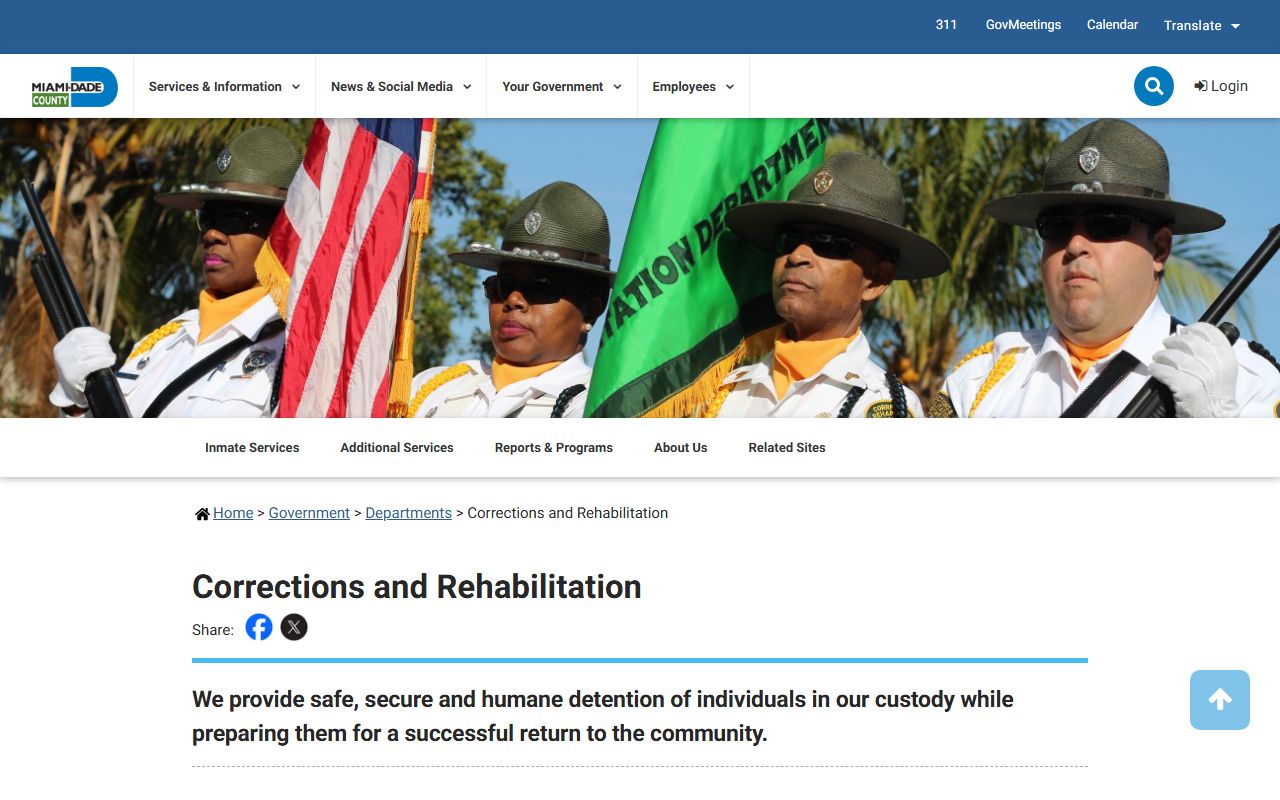
The same homepage states the 4,000 to 4,200 daily range that frames the county inmate population, while the dated daily report gives the exact figure.
| Measure | Figure | Source / Year |
|---|---|---|
| In custody (MDCR) | 4,788 | MDCR Daily Jail Population report, 5/28/2026 |
| 180-day average daily population | 4,648 | MDCR Daily Jail Population report, 5/28/2026 |
| Expected average length of stay | 36.47 days | MDCR Daily Jail Population report, 5/28/2026 |
| Booked that day | 151 | MDCR Daily Jail Population report, 5/28/2026 |
| Released that day | 136 | MDCR Daily Jail Population report, 5/28/2026 |
| MDCR homepage daily range | 4,000-4,200 | MDCR homepage / reports page, 2026 |
One caution matters here. The county jail count should not be added to state, federal, or immigration facility populations. Those are separate custody systems, counted by separate agencies. The 4,788 figure is the MDCR county number alone.
Miami-Dade County Inmate Population Trends
Year-over-year figures for the Miami-Dade County inmate population come from the Miami-Dade Commission Auditor 2025 Performance Measures Report. That report tracked bookings per month and average daily population across three fiscal years. The trend is mostly upward. The average daily population rose from FY 2022-23 to FY 2023-24, then dipped slightly. Bookings climbed steadily across the same span. The auditor noted that bookings increased by 4,650 from FY 2022-23 to FY 2024-25. The Miami-Dade County jail population stays large because of high booking volume, not long stays.
| Year | Average Daily Population | Notes |
|---|---|---|
| FY 2022-23 | 4,585 | Commission Auditor 2025 report; felony ADP 4,237, misdemeanor 269. |
| FY 2023-24 | 4,710 | Commission Auditor 2025 report; up from prior year. |
| FY 2024-25 | 4,674 | Commission Auditor 2025 report; flagged as unverified by OCA at the time of the report. |
| Past 180 days (5/28/2026) | 4,648 | MDCR Daily Jail Population report. |
Note: The FY 2024-25 figure carries an official caveat, since the Commission Auditor report marked that year's amount as not yet verified by the Office of the Commission Auditor.
Who Makes Up the Miami-Dade County Inmate Population
The MDCR Daily Jail Population report breaks the Miami-Dade County inmate population down by sex, charge level, charge status, age, and race. The figures below are from the May 28, 2026 report. Men make up the large majority. Most people are held on felony charges. Most have not been sentenced, meaning they sit in jail before trial. A smaller group has a partial sentence or a finished sentence. Immigration holds add another layer that does not fit the criminal categories.
- Sex - 4,241 men (88.58%) and 547 women (11.42%) on May 28, 2026.
- Charge level - 4,097 people (85.57%) held on felonies, 565 (11.8%) on misdemeanors.
- Charge status - 3,768 unsentenced (78.7%) and 675 with a partial sentence (14.1%); the rest are sentenced.
- Age - the largest groups were 25-34 (1,394) and 35-44 (1,415); 26 people were 17 or under and 163 were 65 or older.
- Race - 2,446 Black, 2,331 White, and 11 Asian by arrest-affidavit data.
- Immigration holds - 637 holds or detainers in the seven-day window ending May 28, 2026.
Charge status is the key to reading this data. Unsentenced means a person is in custody but the case is not resolved. A detainer is a hold placed by another agency, such as immigration, that keeps a person in jail beyond a local release. Both push the count up without a conviction behind them.
Miami-Dade County Jail Capacity and Overcrowding
Capacity is harder to pin down than population. No current systemwide rated capacity for the whole MDCR jail system was located on a current public page. The figures that exist are document-dependent, meaning they change with the source and the year. Turner Guilford Knight Correctional Center was listed at a designed capacity of 1,561 in a 2024 PREA audit, but an older 2018 county RFP listed 1,377. Metro West Detention Center appeared at 2,862 beds in a 2018 commissary RFP. Pre-Trial Detention Center was described as a 1,712-bed facility in a 2019 county resolution and 1,499 in an older RFP.
Because the numbers shift by document, any capacity claim should carry its source and date. The Miami-Dade County jail facility daily counts tell the load story better. On May 28, 2026, Metro West held 2,430 people, the Pre-Trial Detention Center held 1,143, and TGK held 1,098. Those counts come from the same daily population report that gives the systemwide total.
Note: A 2026 local report discussed a stalled mental-health facility and claimed a large share of the jail population has mental illness, but no official county figure confirmed that share.
Laws Governing the Miami-Dade County Inmate Population
Public access to Miami-Dade County jail data rests on Florida law. The state's public records act makes most agency records open unless a specific exemption applies. Booking information, jail numbers, and custody status are generally open under that framework. Fees for copies are set by statute. Jail operating standards come from a separate law and a statewide model. Death-in-custody reporting runs through federal programs rather than a single county dashboard. Each rule below carries one plain-English line on what it does.
Key Statutes and Rules:
Florida Statutes Chapter 119 - the public records act; agency records are open to any person unless a specific exemption applies.
Florida Statutes § 119.07 - governs inspection, copying, and the fees a records custodian may charge.
Florida Statutes § 951.23 - requires county detention facilities to adopt at minimum the Florida Model Jail Standards.
Florida Statutes § 901.43 - sets a written-request process for removing published arrest booking photographs.
BJA Death in Custody Reporting Act - states that take federal grant funds must report deaths of people held in local jails, prisons, and similar settings.
The Florida Model Jail Standards set the floor for how county jails handle housing, food, medical care, discipline, and classification. The BJS Mortality in Correctional Institutions program collects jail and prison death data at the national level, since no Miami-Dade jail death dashboard was located in the captured official pages.
Miami-Dade County and the State Prison Population
Once a Miami-Dade County defendant is sentenced to state prison, the count shifts. That person leaves the MDCR county roster and joins the Florida Department of Corrections (FDC) population. FDC is Florida's third-largest state prison system. Its homepage says it incarcerates more than 80,000 inmates and supervises more than 146,000 people in the community. Several FDC prisons sit inside Miami-Dade County, so a person can move from the county jail to a state prison without leaving the area.
The local state facilities include Dade Correctional Institution, Everglades Correctional Institution, Homestead Correctional Institution, South Florida Reception Center, and Everglades Re-Entry Center. South Florida Reception Center matters most for movement, because it receives newly sentenced men from county jails for classification before assignment. These are facility populations, not Miami-Dade arrest totals, and they are searched through the FDC Corrections Offender Network rather than the county roster.
How to Search the Miami-Dade County Inmate Population
The Miami-Dade County jail roster is the starting point for any current lookup. MDCR runs a free online inmate search. It covers people in MDCR custody and, per the county FAQ, people released within the last 72 hours. The form is simple. It asks for a last name and a first name, each with a three-character minimum. No login, booking number, or date of birth is needed to start.
Before searching, have the person's name ready. The exact spelling helps. If the spelling is uncertain, the first few known letters of each name can still pull matches. The MDCR inmate search form shows both fields and a Search button.
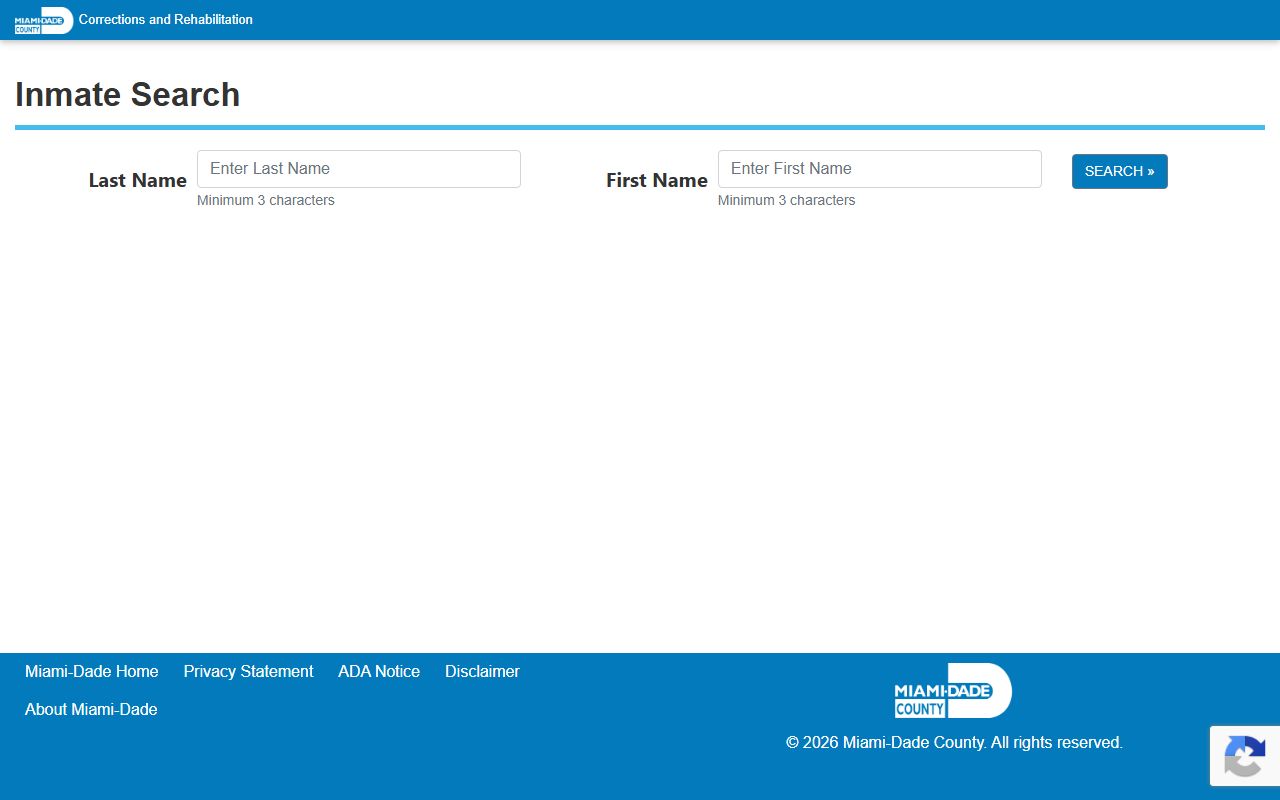
That form is where a Miami-Dade County inmate search begins, returning a results grid once a name is entered.
- Open the MDCR inmate search page at miamidade.gov.
- Type at least three characters of the inmate's last name.
- Add at least three characters of the first name, or the best known first letters.
- Select the "Search »" button to run the search.
- Open the result for name, charges, bond, jail number, location, and mugshot.
- If the person was sentenced to state prison, check the FDC offender search instead.
Current Inmate Lookup in Miami-Dade County
The live Miami-Dade County jail roster updates as people move through custody, though a very recent arrest may still be processing at TGK. The public form exposes only two text fields. There is no booking-number box, no date-of-birth box, and no facility dropdown on the public search. A results grid appears after the search runs. The table below lists the search fields the county exposes and how each behaves.
| Field Label | Type | Required | Notes |
|---|---|---|---|
| Last Name | Text | Functionally needed | Placeholder "Enter Last Name"; minimum 3 characters. |
| First Name | Text | First initial or first name | Placeholder "Enter First Name"; minimum 3 characters. |
| Search » | Submit button | n/a | Runs the search and shows the results grid. |
One location code trips people up. If the location column reads NDCCC, the person is not physically in jail. NDCCC means house arrest with ankle-bracelet monitoring. The North Dade Community Correctional Center it once referred to is no longer open.
Past and Released Inmate Records
The Miami-Dade County jail roster is built for current custody. Its reach into the past is short. The MDCR FAQ says the inmate search also lists people released within the last 72 hours. Beyond that window, a released person usually drops off the online search. The record itself does not vanish. Booking and corrections records can still be requested through MDCR Central Records or the county's GovQA public records portal.
A records request should name the inmate, the jail number if known, the date range, and the exact record sought. Booking photos and corrections files held by the agency are generally public under Chapter 119, subject to exemptions. A person sentenced to state prison will not appear on the county roster at all after transfer. For that person, the FDC offender search is the right tool, not the county jail roster.
What a Miami-Dade County Inmate Record Shows
A roster result is more than a name. The Miami-Dade County service page lists the fields each in-custody record displays. The table below walks through the main fields and what each one tells you. Charges shown here are booking charges, which can differ from the charges the State Attorney later files in court.
| Field | What It Shows |
|---|---|
| Name and Date of Birth | The person in custody; the DOB helps tell apart same-name results. |
| Race and Sex | As listed in MDCR case data. |
| Location | The facility or location code; NDCCC means house arrest, not physical custody. |
| Charges | Booking charges, which may differ from the prosecutor's filed court charges. |
| Bond Amount | The bond if the charge is bondable; call inmate information if unsure. |
| Jail Number | The MDCR identifier used for mail, deposits, and records requests. |
| Booking Date and Time | When the person entered MDCR custody. |
| Mugshot | The booking photo shown in the search result. |
Booking photos for current inmates appear directly in the roster result, and the Miami-Dade County jail mugshots page covers how long they stay public and how to request one.
County Jail vs. State Prison: Where to Look
The single biggest mistake in inmate searches is using the wrong system. Pre-trial detainees and people serving short county sentences sit in the Miami-Dade County jail run by MDCR. Sentenced felons move to an FDC state prison, a separate count with a separate locator. A person in one system will not show in the other. The comparison below sorts out which tool covers which slice of the population.
| County Jail | State Prison (DOC) | |
|---|---|---|
| Who Is Held | Pre-trial plus sentences of 364 days or less | Sentenced state felons |
| Run By | Miami-Dade Corrections and Rehabilitation Department (MDCR) | Florida Department of Corrections (FDC) |
| Where to Look | MDCR inmate search | FDC offender search |
| Stays Listed | Current inmates plus releases within 72 hours | Through the sentence; population refreshed weekly |
The FDC offender search is the right place once a person is sentenced to state prison.
State and Federal Inmate Search
Four locators cover the rest of the custody map beyond the Miami-Dade County inmate population. Each handles a different population, and none replaces the others. A sentenced state prisoner is found through FDC. A federal inmate is found through the Bureau of Prisons. An immigration detainee is found through ICE. VINELink sits across these as a notification layer for custody and case-status updates.
The FDC offender search menu lets you search the state's databases, and the menu page shows the separate population, release, and supervised searches.
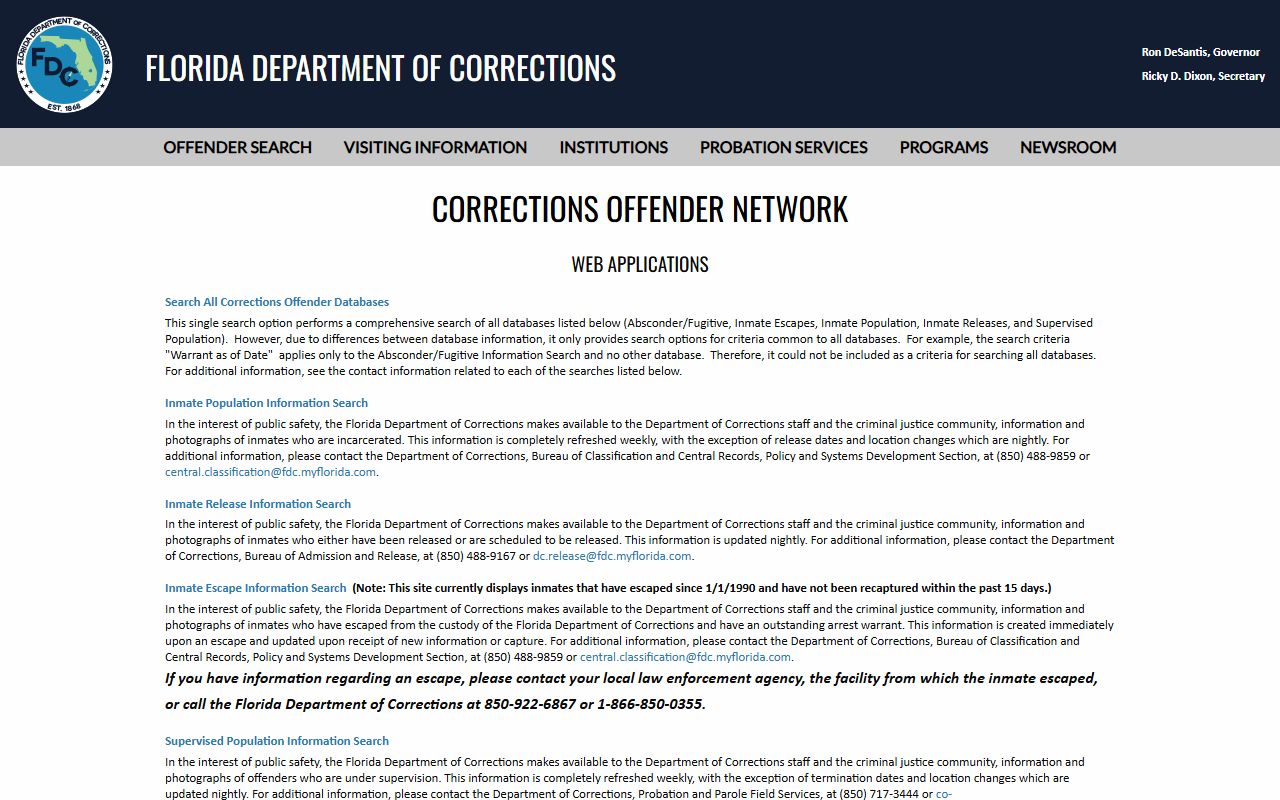
That menu is the gateway for state prisoners who have left the Miami-Dade County inmate population for FDC custody.
For federal custody, the BOP inmate locator covers federal inmates from 1982 to the present. For immigration custody, the ICE Online Detainee Locator System finds people in ICE custody by A-number or by exact name plus country of birth. For release and status alerts across systems, VINELink handles registration and notifications in Florida.
Miami-Dade County Detention Facilities
The Miami-Dade County inmate population is spread across MDCR jails, while state, federal, and immigration detainees are held in separate facilities inside the county. The list below names each facility and who it holds. County jails use the MDCR roster. State prisons use the FDC search. Federal sites use the BOP locator, and the ICE facility uses ODLS.
- Turner Guilford Knight Correctional Center - MDCR central intake and release jail for county pre-trial and short-sentence inmates.
- Metro West Detention Center - the largest MDCR housing site, holding a big share of the county jail population.
- Pre-Trial Detention Center - downtown MDCR jail tied to bond hearings and court geography.
- Miami-Dade Corrections Boot Camp Program - county program for young convicted offenders, primarily ages 14 to 24.
- Dade Correctional Institution - FDC male state prison for sentenced Florida prisoners.
- Everglades Correctional Institution - FDC male state prison near the Everglades corridor.
- Homestead Correctional Institution - FDC female state prison for sentenced women.
- South Florida Reception Center - FDC reception center that classifies newly sentenced men from county jails.
- Everglades Re-Entry Center - FDC re-entry site for sentenced state inmates in transition programming.
- Federal Correctional Institution Miami - BOP low-security prison and camp for sentenced federal inmates.
- Federal Detention Center Miami - BOP detention center for federal pretrial and holdover detainees.
- Krome North Service Processing Center - ICE facility holding immigration detainees, not county jail inmates.
Miami-Dade County Inmate Population FAQ
How big is the Miami-Dade County inmate population?
The MDCR Daily Jail Population report for May 28, 2026 listed 4,788 people in custody. The 180-day average daily population was 4,648. The MDCR homepage describes a daily range of 4,000 to 4,200 people. MDCR calls itself the eighth-largest jail system in the United States. The exact number changes every day as people are booked and released, so the dated daily report gives the most precise figure.
How do I search the Miami-Dade County inmate population?
Use the MDCR inmate search at miamidade.gov. Enter at least three characters of the last name and three of the first name, then select the Search button. The result grid shows name, date of birth, race, sex, location, charges, bond, jail number, booking date and time, and a mugshot. The search covers people in MDCR custody and, per the county FAQ, those released within the last 72 hours.
Can I look up a released or past inmate?
Yes, within limits. The MDCR inmate search lists people released within the last 72 hours. After that window, a released person usually drops off the online roster. The underlying record can still be requested through MDCR Central Records or the county GovQA public records portal. A name, jail number, and date range speed up that request.
Why can't I find someone who was just arrested?
Booking takes time. A very recent arrestee may still be processing at TGK, so charges and bond may not be posted yet. The MDCR site can also show a maintenance page when the search is down. If the person does not appear, call MDCR inmate information or the TGK Information Desk before assuming there is no custody record.
Who is counted in the Miami-Dade County inmate population?
The MDCR count includes people held in county detention facilities, both pre-trial and serving sentences of 364 days or less. It does not include people in state prison, federal custody, or ICE detention. Those are separate systems with separate counts. The county count should never be added to state, federal, or immigration facility populations.
What is the difference between the county jail and a state prison search?
The county jail holds pre-trial detainees and short-sentence inmates, searched through the MDCR roster. A state prison holds sentenced felons, searched through the FDC offender search. When a person is sentenced to state time, the lookup shifts from the county roster to FDC. Federal inmates use the BOP locator, and immigration detainees use the ICE locator.